
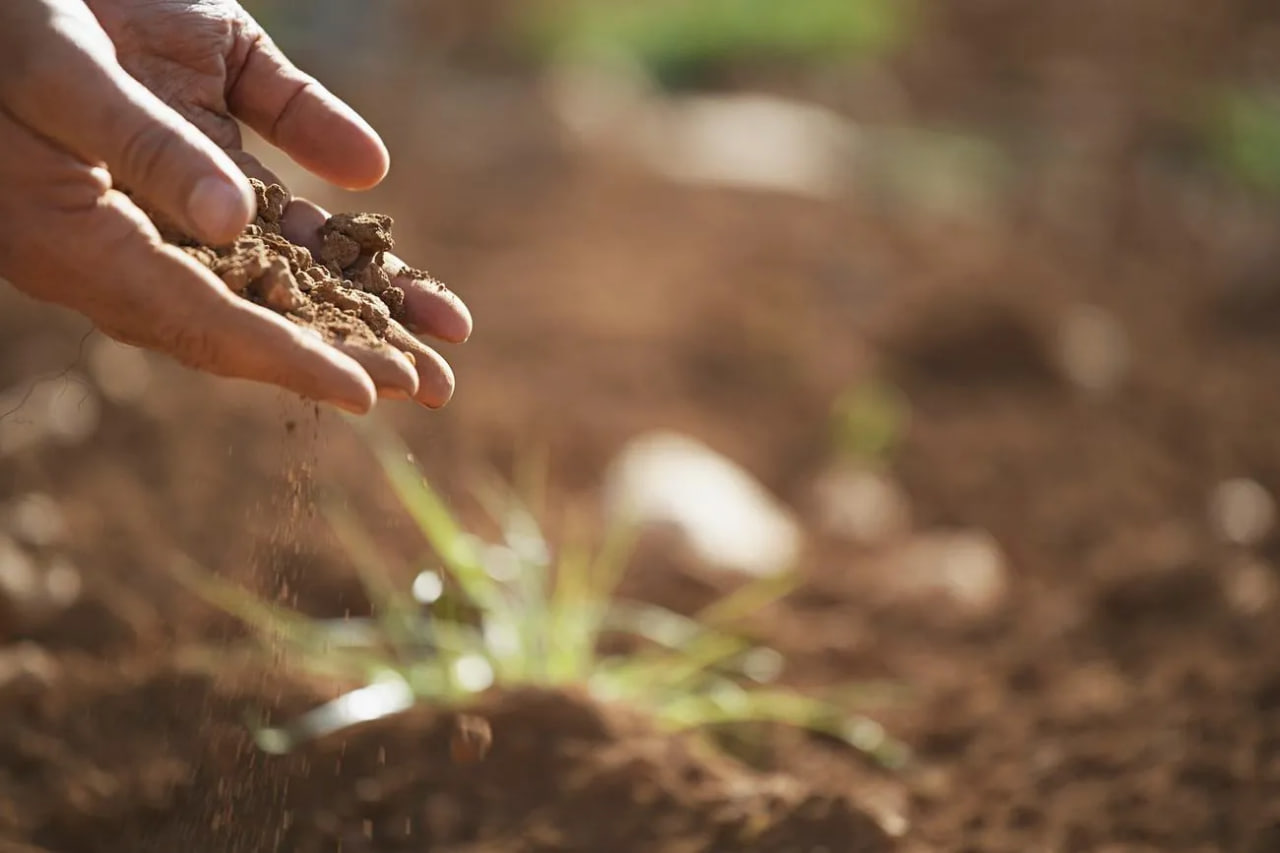
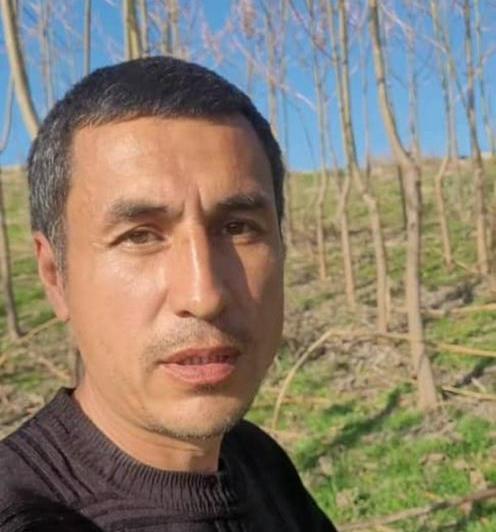
Otabek Nuritdinov, a 41-year-old resident of the Asaka district in the Andijan region, is doing something in Uzbekistan that no one has done before: transforming desert hills into a forest. In 2022, he purchased several dozen hectares of sun-dried land at an auction and began planting trees.
Nuritdinov is neither an agronomist nor an official; he is a former blogger from Asaka, known for his civic activism on social media. The funds for the project are his own: part of it went to solar panels to supply water to the hills. Seeds are sent by compatriots from Poland, the USA, and Turkey; followers on social media provide small financial support. Otabek shared his story with Fergana news agency.
— Please tell us how the idea of planting a forest in the Andijan region, in the desert, came about? Where did this desire come from?
— I was born in 1983. When I was a child, there was a lot of snow in our Andijan during the winter — even snowplows were in operation back then. And there were also heavy rains, downpour-like. If you remember that time and compare it with today, you can see the climate changes with the naked eye. Everything that scientists talk about is already happening.
I remember UN Secretary-General António Guterres presented a major report on climate change in 2020 or 2021. It was prepared by more than two hundred scientists from around the world. The report explicitly stated that Central Asia would become one of the most vulnerable regions. By 2050, mass migration of the population might occur here due to worsening living conditions.
And where does our water come from? Mainly from Kyrgyzstan and Tajikistan. In spring, glaciers melt there, forming rivers — the Amu Darya, the Syr Darya. They feed all of Central Asia. But today, glacier melting is accelerating, and scientists now acknowledge that changes are happening much faster than previously predicted. The region may face irreversible consequences much sooner than 2050.
We used to have many trees. I remember trees growing everywhere in courtyards, greenery was all around. You could walk to the market for three or four kilometers — and the entire road was in the shade. Now, almost none of those trees remain. In summer, walking even a couple of kilometers under the sun is a real challenge.
I’ve been interested in ecology for a long time, observing climate change. Seeing more and more desert areas around, I began looking for examples of successful solutions. I watched how it’s done in China — they historically have real deserts, but they are turning them into green zones, creating forests. I was also interested in the Korean experience.
During World War II, when Korea was under Japanese occupation, the Japanese cut down vast areas of forest — millions of hectares. The land began to degrade, and desert areas appeared. Then the Koreans massively started planting new trees. People worked shoulder to shoulder, without machinery, by hand. And they managed to restore the forests. Now in South Korea, there are no longer the desert areas that were once called savannas.
Some say, “Well, they have a different climate, they have more rainfall.” But if you remember, it used to be different here too — rains were more frequent, and snow fell regularly in winter. We’ve simply lost the balance, and it needs to be restored.
After deforestation, we also had less precipitation. Why? Because trees have a special property: they evaporate moisture into the atmosphere. This moisture rises, mixes with clouds passing over us, and as a result of this reaction, rain falls. Trees literally cause rain. Moreover, they lower the air temperature by several degrees and retain moisture in the soil.
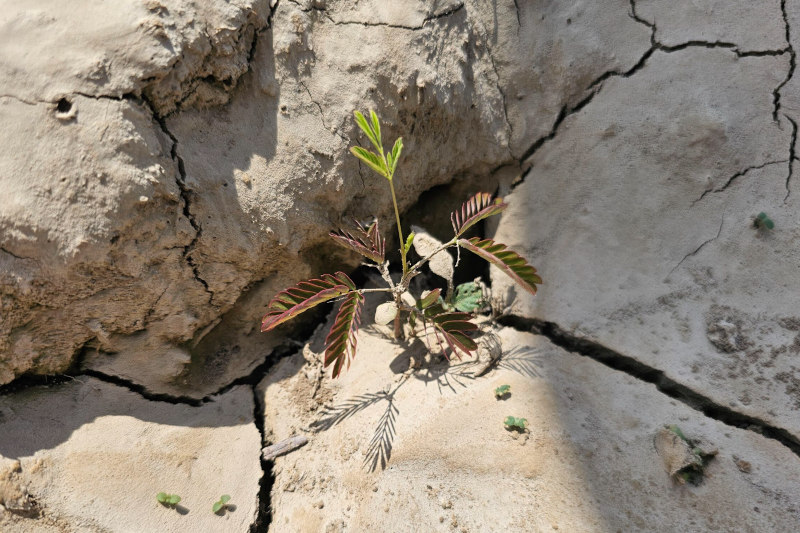
In desert, open areas, it’s different: after rain, the land becomes dry again in a few days. The sun comes out, the soil heats up — and all the moisture evaporates, carried away by the wind. There’s nothing to retain it. As a result, groundwater also disappears — simply because there are no plants. We’ve ruined our own ecology. Yet, trees and all vegetation raise groundwater levels, cause rains, and enrich the air with oxygen.
All these observations prompted me to act. I thought: if we plant as many desert lands as possible with trees and turn them into forests — people will breathe better, health will improve, there will be places for recreation, moisture will be preserved, groundwater levels will rise. It all came together in my mind as a complete picture — and I started planting the forest.
I plant densely because the problem of water scarcity becomes more acute every year. When the forest is formed, fallen leaves and branches will create natural mulch. Microorganisms and bacteria will develop in it. Tree roots, as they die, form microchannels in the soil, where worms and other organisms live — they also make passages. As a result, the ground turns into a natural reservoir: rainwater and meltwater go deep, rather than evaporating. Tree canopies protect the soil from overheating.
— What area have you already planted?
— According to Google Maps, just under three hectares.
— What trees are you planting?
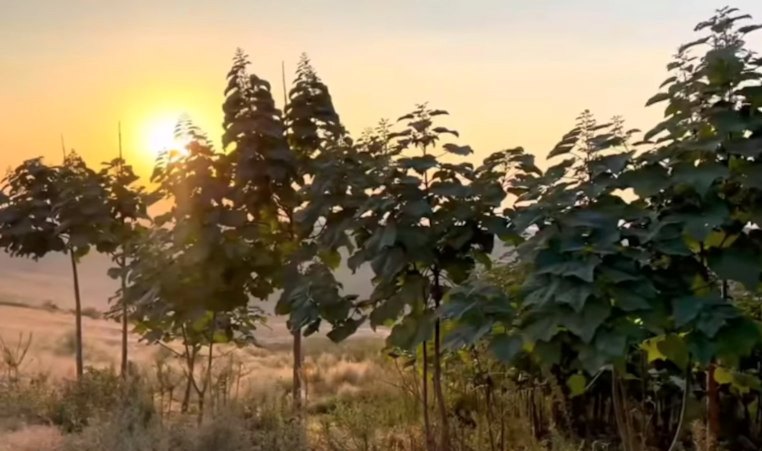
— Various types. There is elm, willow, mulberry, fruit trees, paulownia. The elm grows poorly — last year some disease ate the leaves, I saw the same thing happening throughout Uzbekistan. The willow dried up in many places — there were irrigation problems. But the paulownia turned out to be very resilient and grows quickly. It’s everywhere now, and under it, there are willow and mulberry. This year, we are sowing oak acorns under the paulownia: when the oak grows in the shade, we will cut the paulownia.
Overall, we plant what we can find on our own — there is no opportunity to buy planting material, and we don’t have our own nursery yet. We wanted to build a greenhouse to grow seedlings ourselves. But unforeseen expenses arose — we had to install solar panels, and the money went there. So the greenhouse didn’t happen. Without it, it’s almost impossible to grow decent planting material in open ground.
— I’ve read that you’re investing your own funds. Is there any business component to this? Do you plan to reach self-sufficiency, for example, by selling seedlings?
— Initially, that was our idea: to grow seedlings, sell part of them, and use the rest for planting. But due to unforeseen expenses, we couldn’t build the greenhouse. A year and a half ago, we calculated it would cost around 250 million soms. Now, it’s probably 300 or more — we haven’t recalculated.
— What size is the greenhouse?
— 16 by 90 meters.
— How are things with taxes and land?
— That’s a whole different story. In Uzbek legislation, there is no concept of “private forestry.” Neither a ban nor permission. But in practice, the absence of permission means prohibition — all doors are closed.
When we started, we just wanted to take vacant land for tree planting. We were told: by law — only through auction. We bought the land at auction, and then within five days, we were required to establish a farm and attach the land to it. So we did.
When we contacted the tax authorities, as a new farm, we were given a five-year tax holiday. It’s been two and a half years now — it will be three in September. But there was already a curious incident: we were automatically charged 211 million soms in taxes based on the scheme for dekhkan farms. After I publicly wrote about it, the error was corrected. So, publicity really helps us.
Initially, we had 220 hectares, then we kept 45. If the taxes after the grace period become unbearable — we will keep the 10-15 hectares we manage to develop and return the rest.
— Is anyone from the officials willing to help?
— Many want to. We communicate with both republican structures and the leadership of the forestry department. There are people willing to assist. But they can’t directly help: we are a farm, and any funding towards us would formally look like an illegal operation. Many tried to find a way out — a legal solution hasn’t been found.
— Are there any conflicts with local authorities?
— No, they aren’t putting up any obstacles. We are working peacefully.
— Who helps you with the work?
— It’s just my wife and me. We get up early in the morning, work until evening every day. The children sometimes help during school holidays — planting seeds and doing small tasks. But they live with their grandmother in the city and study there.
— What is your main goal now?
— To turn as much land as possible into a forest, and for information about us to reach the highest levels. More and more people are learning about our project, and the number of followers is growing. If someone from those who make decisions comes and sees with their own eyes: there was a desert here — and now there is a forest, it might change something.
Many enthusiasts call me, asking for advice. But honestly, while there is no proper legislative framework, I dissuade many — it’s not worth getting involved. If we manage to convey our experience to the authorities and achieve the adoption of the corresponding law, thousands of degrading lands across the country can be turned into forests. When a forest reaches a certain density, after a few years it no longer needs irrigation — it lives on its own. That’s what we’re striving for.
