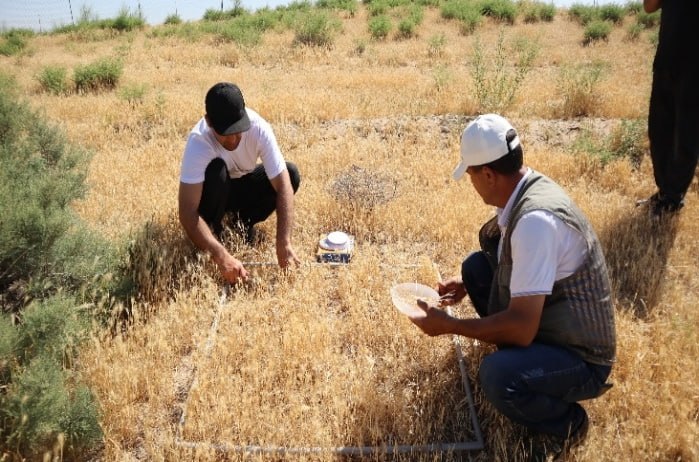
In May 2026, as part of the project “Restoration of Resilient Landscapes in Tajikistan,” an assessment of the condition of pastures in the Shahritous, Qubodiyon, and Nosir-Khusrav districts of the Khatlon province was conducted.
The monitoring involved specialists from the Institute of Animal Husbandry and Pastures of the Academy of Agricultural Sciences of Tajikistan, technical specialists from the target areas, as well as pasture management experts.
The aim of the monitoring was to study the condition of pastures, evaluate the effectiveness of fencing degraded areas, determine the productivity of forage lands, and analyze the impact of project activities on the restoration of natural resources.
The pastures in these areas are classified as winter pastures. Their productivity directly depends on the amount of precipitation. Spring rains can increase the yield of natural forage lands two to three times, while dry years, conversely, reduce the forage base for livestock.
The studies showed that through the rational use of pastures and the establishment of pasture user associations, it was possible to improve land conditions and increase their productivity.
The Qubodiyon district has over 89 thousand hectares of pastures. With the support of the project, seven pasture user associations were established here, which were allocated more than 10 thousand hectares of land.
By 2026, a pasture rotation system was organized over an area of 8,145 hectares. On the Chirik site, belonging to Takhti Sangin Company, a three-hectare fenced area showed an average yield of 2.5 quintals of dry forage mass per hectare. On another site, the yield was about 4.5 quintals of dry mass per hectare.
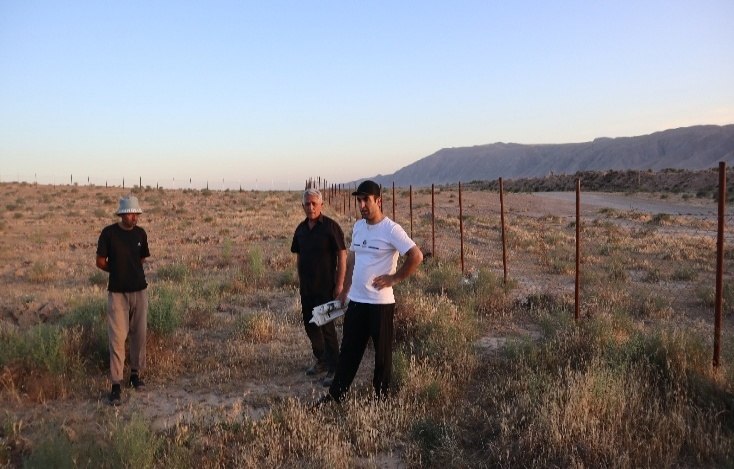
At the Kurjolokum site, where protective plantings of saxaul were created over an area of 200 hectares, the productivity of vegetation was two to three times higher than on open areas. Here, the yield of pastures reached 8-9 quintals of dry forage mass per hectare.
In the Shahritous district, the total area of pastures is over 107 thousand hectares. Within the framework of the project, seven pasture user associations were established here, covering more than 8 thousand hectares of land.
A pasture rotation system was implemented over an area of 6,585 hectares. As a result, the yield of pastures increased by 15-25% compared to previous years.
On the demonstration site of Sayod, a two-hectare fenced area showed a yield of 9.5 quintals of dry forage mass per hectare. Compared to last year, productivity increased by 30-40%.
In the Nosir-Khusrav district, there are over 55 thousand hectares of winter pastures. Here, the project created six pasture user associations, covering more than 2,100 hectares of land.
A pasture rotation system was organized over an area of 1,727 hectares. This allowed for an increase in pasture productivity of about 15% compared to last year.
On the site of the pasture user association Istiqlol, 3 hectares of degraded land were fenced. Here, it was possible to restore the natural grass stand even on sandy and gravelly soils.
Additionally, more than 500 seedlings of pistachio were planted on this site. According to research data, the yield of natural forage lands here ranged from 6.5 to 7.8 quintals of dry forage mass per hectare, which is 15-20% higher than previous years’ figures.
The project “Restoration of Resilient Landscapes in Tajikistan” is part of the World Bank’s RESILAND CA+ program aimed at enhancing the resilience of regional landscapes in Central Asian countries. The project is also being implemented in Kyrgyzstan and Uzbekistan.
The Regional Environmental Center for Central Asia is implementing the regional component of the project “Restoration of Resilient Landscapes in Tajikistan.”