
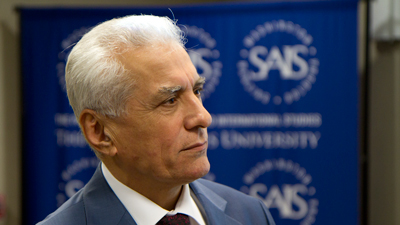
Tajikistan expects that the World Bank will finalize its feasibility study on the Roghun hydropower station in February of 2013, according to the Foreign Minister of Tajikistan Hamrokhon Zarifi.
“We have had several negotiations on this case and now hope that the final paper will be ready in February of the next year,” Zarifi told U.S. and international foreign policy experts at the Central Asia-Caucasus Institute (CACI) at Johns Hopkins University’s Paul H. Nitze School of Advanced International Studies (SAIS) on Thursday.
“Three years ago we asked the World Bank to send experts and to make more feasibility studies, because Roghun, actually, has had several feasibility studies already. And we are doing this now in cooperation with the World Bank. A team from World Bank is working in Tajikistan. They are accessing everything and this includes economic stage, ecological stage and the future of all Central Asian stations. We are working on it,” Zarifi said.
According to the World Bank, it is funding two studies on Roghun, including a Techno-Economic Assessment Study (TEAS) being conducted by an international consortium of well known engineering firms of Coyne et Bellier (France), Electroconsult (Italy) and IPA Energy & Water Consulting (UK), as well as an Environmental and Social Impact Assessment (ESIA) conducted by Poyry (Switzerland). Both studies are conducted by international consultant firms contracted on a competitive basis by the Government of Tajikistan and financed through an IDA project with assistance of World Bank experts.
The World Bank has also established two independent Panels of Experts (PoEs): an Engineering and Dam Safety Panel and an Environmental and Social Impact Assessment Panel. The role of the Panels is to ensure due diligence and international quality standards, as well as objectivity and credibility through independent advice and guidance. The Panels of Experts are composed of recognized international professionals.
The proposed Roghun Hydropower Project (HPP) on the Vakhsh River in Tajikistan with a total capacity of 3,600 megawatt would be the highest dam in the world with a maximum height of 335 meters and surpassing China’s Three Gorges dam built in 2008. Roghun HPP is expected to produce 13.3 Terawatthours [TWh – trillion watthours] of electrical power per year.
“Due to significant changes in hydropower development and climate science over the past three decades, Tajikistan needs to apply modern international knowledge and standards to ascertain the public safety and long-term economic viability of the project. Moreover, for credibility in the international community, there needs to be a transparent due diligence process following international practices, overseen by independent experts,” the World Bank said in its latest official Update on the Status of the Roghun Assessment Studies released in Washington last December.
