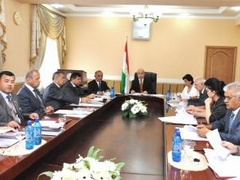
DUSHANBE, January 21, 2013, Asia-Plus — The board (Shuro) of Tajikistan’s lower house (Majlisi Namoyandagon) of parliament voted down the amendments offered to country’s law on presidential election by the Islamic Revival Party (IRP) at a January 21 meeting, presided over by its head, Shukurjon Zuhurov, Muhammadato Sultonov, a spokesman for the Majlisi Namoyandagon, told Asia-Plus in an interview.
We will recall that MPs Muhiddin Kabiri and Saidumar Husaini, who represent the IRP in the Majlisi Namoyandagon, have worked out amendments to the Constitutional Law “On Election of the President of the Republic of Tajikistan,” which was adopted in July 1994. They, in particular, propose to provide equal representation of political parties in electoral commissions at all levels. They also propose that a candidate for the post of the President should have the support of two percent of citizens of the Republic of Tajikistan who have universal suffrage.
Under the current law, a candidate for the post of the President shall have the support of 5 per cent of citizens of the Republic of Tajikistan who have universal suffrage.
Besides, the IRP MPs propose that candidates nominated by political parties, who win five and more percent of the vote, should be exempted from collecting signatures.
Earlier, MP Shodi Shabdolov, who is also leader of the Communist Party of Tajikistan (CPT), said in an interview with Asia-Plus that MPs representing the CPT in the Majlisi Namoyandagon might support IRP’s amendments to the law on presidential election.
Under the current election legislation of Tajikistan, the President of the Republic of Tajikistan is elected by national vote for the seven-year term. Tajikistan held a constitutional referendum on June 22, 2003 and the 2003 Constitution, among other amendments, set a limit of two seven-year terms for the president.
Emomali Rahmon’s election to the office of the president in 2006 counts as his first 7-year term under the 2003 Constitution, and in principle he may be re-elected for a second term in 2013, remaining in office until 2020.
Sultonov noted that the board also considered bills requiring amendments to the laws on the Constitutional Court, courts, state duty, museums and museum stocks, electronic documents.
All these issue swill be considered at the next sitting of the fourth session of the Majlisi Namoyandagon of the fourth convocation that will take place on January 23, the spokesman added.