
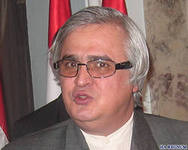
DUSHANBE, April 2, 2013, Asia-Plus — Political, economic and territorial disputes that are a legacy of the Soviet period have caused many serious geopolitical problems in Central Asia’s nations, Iranian Ambassador to Tajikistan, Mr. Ali-Asghar Sherdoust, stated at an international conference in Dushanbe on April 2.
According to him, formation of a new geopolitical space in Central Asia is the result of key changes that took place after the end of the Cold War.
“These changes have caused a power vacuum in the region,” Iranian diplomat said, noting that the Central Asian region has turned into arena of struggle for regional and trans-regional supremacy.
“Regional and world powers are struggling for their interests in this region,” Ambassador Sherdoust noted.
In his opinion, the United States is pursuing certain goals in Central Asia, including control of energy resources as well as preventing increase in influence of Iran and reviving Russian influence in Central Asia.
“Central Asia’s energy resources are valuable raw materials for the United States,” Mr. Sherdoust stressed.
“According to authenticated data, Central Asia’s general oil reserves are estimated at 15-31 billion barrels and its general natural-gas reserves are estimated at 230-260 trillion cubic meters, 7.2 and 7.0 percent of world oil and natural-gas reserves respectively,” Iranian diplomat said.
On the presence of Russia in the region, Ambassador Sherdoust noted that Russia’s policy in the region was quite understandable. “This country has been taking efforts to support stability in the region and prevent foreign influence on the countries of the region,” he noted.
Concerning Iran’s interest in the Central Asian region, Sherdoust noted that it was conditioned by historical, cultural and religious commonalities between Iran and the Central Asian nations.
Organized by the Russian Embassy in Dushanbe and Russian-Tajik Slavic University (RTUS) in Dushanbe, the conference formally titled “Geopolitical Trends in Central Asia at the Beginning of the 21st Century: Problems of Integration, Security and Inter-Civilization Cooperation” took place at the Russian Center of Russia’s Russkiy Mir (Russian World) National Foundation at RTSU.
