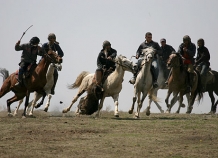
KHUJAND, February 12, 2015, Asia-Plus — Buzkashi masters and horse riders in the northern province of Sughd are making preparations for Navrouz competitions
By Sughd governor’s order the Buzkashi game and horse race will take place at the hippodrome in the Bobojonghafourov district on March 23 on the occasion of the Navrouz holiday.
According to the Sughd regional administration press center, the contests will be held for purpose of propagating national traditions and promoting development of horse breeding in the country.
Buzkashi (literally “goat dragging” in Tajik) is a traditional Central Asian team sport played on horseback. The steppes” people were skilled riders who could grab a goat or calf from the ground while riding a horse at full gallop. The goal of a player is to grab the carcass of a headless goat or calf and then get it clear of the other players and pitch it across a goal line or into a target circle or vat. It is very dangerous.
The game is known as Buzkashi in Tajikistan and Afghanistan and among Persian-speaking populations of Central Asia, while in Kyrgyzstan, Kazakhstan, and Uzbekistan, the game is referred to as Kok-boru or Ulak Tartysh
Buzkashi began as a sport of the steppes. It is a popular game among the south Central Asians such as the Tajiks, Uzbeks, Hazars, Kyrgyz, Kazakhs, Turkmens and Pashtuns. The Turkic name of the game is Kokboru; Kok = “blue”, boru = “wolf”, denoting the grey wolf—the holy symbol of the Turkic people. Other Turkic names of the game are Ulak Tartish, Kuk Pari, Kok Beru, and Ulak Tyrtysh. Kokboru is the most popular national sport of Kyrgyzstan. In the West, the game is also played by Kyrgyz Turks who migrated to Ulupamir village in the Van district of Turkey from the Pamir region.
Competition is typically fierce, as other players may use any force short of tripping the horse in order to thwart scoring attempts. Riders usually wear heavy clothing and head protection to protect themselves against other players” whips and boots. Games can last for several days, and the winning team receives a prize, not necessarily money, as a reward for their win.
The game consists of two main forms: Tudabarai and Qarajai. Tudabarai is considered to be the simpler form of the game. In this version, the goal is simply to grab the calf and move in any direction until clear of the other players. In Qarajai, players must carry the carcass around a flag or marker at one end of the field, and then throw it into a scoring circle (the “Circle of Justice”) at the other end. The riders will carry a whip, often in their teeth, to fend off opposing horses and riders.
Buzkashi is often compared to polo. Both games are played between people on horseback, both involve propelling an object toward a goal, and both get fairly rough. However, polo is played with a ball, while Buzkashi is played with a dead animal. Polo matches are played for fixed periods totaling about an hour; traditional Buzkashi may continue for days, but in its more regulated tournament version also has a limited match time.
The calf in a Buzkashi game is normally beheaded and disemboweled and has its limbs cut off at the knees. It is then soaked in cold water for 24 hours before play to toughen it. Occasionally sand is packed into the carcass to give it extra weight. Players may not strap the calf to their bodies or saddles. Though a goat is used when no calf is available, a calf is less likely to disintegrate during the game.
Serious Buzkashi players train intensively for years, and many of the masters (called chapandaz) are over forty years old. Playing well also requires specially trained horses that know to stop still when a rider is thrown and to gallop forcefully when their rider gets hold of the calf. These horses can sell today for as much as US$10,000 to 15,000.