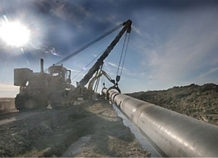
DUSHANBE, February 24, 2015, Asia-Plus — The Ministry of Finance of Tajikistan (MoF) has announced a tender foe selection of a consulting company for providing technical, legal, economic and financial services for implementation of the Turkmenistan-China Gas Pipeline Project.
The MoF Secretariat notes the deadline for applications is March 12, 2015.
We will recall that Tajik President Emomali Rahmon and visiting Chinese President Xi Jinping attended the construction commencement ceremony of the Tajikistan section of Line-D of the China-Central Asia Gas Pipelines on September 13, 2014. The ceremony took place in the Roudaki district.
Line D is the fourth in the pipeline network. The current pipeline network comprising lines A, B and C passes through Uzbekistan and Kazakhstan before reaching China”s western Xinjiang province.
In November 2011, Ashgabat agreed to send an additional 25 billion cubic meters/year of gas to China, bringing total volumes to 65 billion cu m/year by 2020. Some of the additional gas supplies would come from the supergiant Galkynysh gas field in Turkmenistan.
The latest agreement with Tajikistan was signed in Dushanbe between Chinese ambassador to Tajikistan Fan Xianrong and Tajikistan”s First Deputy Minister of Energy and Water Resources Sulton Rahimov in March 2014.
A broad agreement for the project was then signed with Uzbekistan, Tajikistan and Kyrgyzstan during President Xi Jinping”s visit to Central Asia in September 2013.
With a length of only 1,000 kilometers, Line D will be the shortest section of the CACGP network. The pipeline, which at full capacity will carry 30bn cubic meters of natural gas per year, runs from Turkmenistan”s giant gas fields all the way to the Chinese border through Uzbekistan, Tajikistan and Kyrgyzstan. Works at Line D kicked off in September and are now scheduled to wrap up in 2020, although initially the completion date was set for 2016.
Among all countries the pipeline travels through, Tajikistan has the longest section of about 410 kilometers.
In Tajikistan, the gas pipeline will run through Tursunzoda, Shahrinav, Hisor, Roudaki, Vahdat, Fayzobod, Nourobod, Rasht and Jirgatol to Kyrgyzstan’s border.
Tajikistan expects a total income of $3.7bn in transit fees and taxes from the Tajik trunk of “Line D” of the Central Asia–China gas pipeline (CACGP) over 32 years.
Saidahmad Shamsiddinzoda, the head of Open Joint-Stock Company (OJSC) Tojiktransgaz (Tajik state-run natural gas distributor), said during a parliamentary session in Dushanbe on December 9, 2014 that the income of the Tajik-Chinese operator Trans-Tajik Gas Pipeline will be $15bn over 32 years, and of this amount, Tajikistan will receive $1.2bn in the form of taxes and $2.5bn as dividends.
We will recall that Tajikistan had received natural gas from Uzbekistan until 2013. Uzbekistan suspended gas deliveries via pipeline to Tajikistan on December 31, 2012 after both sides failed to agree on gas prices following the expiration of their contract. Uzbekistan, Tajikistan”s only supplier of gas, routinely suspends gas deliveries to its neighbor amid complaints of nonpayment.