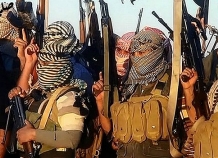
DUSHANBE, March 4, 2015, Asia-Plus — Terrorism is an increasingly global problem that requires concerted global action by a united international community. The Islamic State of Iraq and the Levant (ISIL) phenomenon shows a new type of terrorist organization with unique funding streams that are crucial to its activities; cutting off this financing is therefore critically important.
The Financial Action Task Force on Money Laundering (FATF) last month published a report on the Financing of the terrorist organization Islamic State in Iraq and the Levant (ISIL). This significant report will contribute to the international discussion to update global efforts to counter terrorist financing. The report demonstrates that ISIL is essentially living off the capital illicitly generated by the territory it occupies, primarily by looting banks, exploiting oil fields and robbing economic assets. ISIL can be stifled by frustrating its ability to generate funds from these activities and by preventing it from obtaining funds from other sources and activities.
Using the findings of the FATF report on the sources and methods of financing of ISIL, the FATF and the FATF-Style Regional Bodies (FSRBs) will work together with international organizations to develop proposals to strengthen all counter-terrorism financing tools and report back to the G20 by October 2015.
ISIL, which is the successor to Al-Qaida in Iraq (AQI), has undermined stability in Iraq, Syria and the broader Middle East through its terrorist acts and crimes against humanity, and poses an immediate threat to international peace and security. Prior to ISIL’s expansion of territorial control in parts of Iraq and Syria, the group (and its predecessor, AQI) benefitted from a network of associates in Syria, which it used to facilitate travel to Iraq. ISIL persecutes individuals and entire communities on the basis of their identity, dissent, kidnaps civilians, forces displacement of communities and minority groups, kills and maims children, rapes women and commits other forms of sexual violence, along with engaging in numerous other atrocities. The report notes that ISIL presents a global terrorist threat which has recruited thousands of foreign terrorist fighters (FTFs) to Iraq and Syria from multiple countries across the globe and leveraged technology and other resources to spread its violent extremist ideology and to incite terrorist acts. ISIL seeks to change the political order primarily in the Middle East through its extremist ideology and terrorist violence and aims to bring most traditionally Muslim-inhabited regions of the world under its political control, beginning with Iraq and the Levant.
ISIL obtains the vast majority of its revenues through local criminal and extortion activities in the territory where it operates, which present unique challenges for the international community but also presents a declining revenue base if it is unable to find alternative sources of revenue or take additional territory. Unlike core-AQ, ISIL currently derives a relatively small share of its funds from deep-pocket donors (relative to its other revenue sources), and thus does not depend principally on transferring money across international borders for this purpose. Available research on ISIL’s organizational structure suggests that it is hierarchically organized and that ISIL recreates its top level leadership structure at the group’s provincial level.
ISIL reportedly earns revenue primarily from five sources, listed in order of magnitude: 1) illicit proceeds from occupation of territory, such as bank looting, extortion, control of oil fields and refineries, and robbery of economic assets and illicit taxation of goods and cash that transit territory where ISIL operates; 2) kidnapping for ransom; 3) donations including by or through non-profit organizations; 4) material support such as support associated with FTFs; and 5) fundraising through modern communication networks. These revenue streams are inconsistent and shift based on the availability of economic resources and the progress of coalition military efforts against ISIL.
Recognizing the importance of energy assets as a reliable and sustainable revenue source, ISIL seeks to operate local oil infrastructure, underlining its desire to capture and utilize existing assets and expertise rather than destroy it. However, ISIL cannot effectively manage these assets due to lack of resources and technical capacities. Operating in large swathes of territory in eastern Syria and western and northern Iraq allows ISIL to control numerous oil fields from which it continues to extract oil for its own use, its own refining, and for onward sale or swap to local and regional markets.
ISIL benefits mostly from using the petroleum and petroleum products it controls or by earning revenue from sales of these resources to local customers. The remaining portion of ISIL’s oil revenue stems from sales routed through middlemen and smugglers who trade and transport the illicit petroleum and petroleum products for sale to end-users within the territory where ISIL operates and to nearby areas, including to the Syrian regime as noted by several delegations. This revenue stream may also include swapping ISIL crude oil for exported or imported petroleum products to and from Iraq and Syria, the report says.
The Financial Action Task Force (FATF) is an independent inter-governmental body that develops and promotes policies to protect the global financial system against money laundering, terrorist financing and the financing of proliferation of weapons of mass destruction. The FATF Recommendations are recognized as the global anti-money laundering (AML) and counter-terrorist financing (CFT) standard.