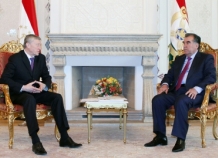
DUSHANBE, March 14, 2015, Asia-Plus — On Friday March 13, Tajik President Emomali Rahmon received visiting Secretary-General of the Collective Security Treaty Organization (CSTO), Nikolay Bordyuzha.
They reportedly discussed a broad range of issues related to cooperation between the CSTO member nations and the Organization’s activities.
Bordyuzha, in particular, told journalists after a meeting with President Rahmon that they had discussed the Tajik-Afghan border control problems and the current situation in Afghanistan.
According to him, they also discussed further expansion of military and technical cooperation within the framework of the CSTO.
Rahmon and Bordyuzha reportedly also exchanged views on combating drug trafficking and measures to provide information security.
The CSTO secretary-general stressed that a special attention was paid to coordination of efforts to fight extremism and terrorism, “especially against the backdrop of the latest developments in Afghanistan, Syria, Iraq and some other countries.”
“Besides, we discussed the Ukraine crisis, aggravation of conflict in Nagorno-Karabakh and so forth,” Mr. Bordyuzha said.
The regional security organization was initially set up in 1992 in a meeting in Tashkent and Uzbekistan once already suspended its membership in 1999. However, Tashkent returned to the CSTO again in 2006 The regional security organization was initially formed in 1992 for a five-year period by the members of the CIS Collective Security Treaty (CST) — Armenia, Kazakhstan, Kyrgyzstan, Russia, Tajikistan, and Uzbekistan, which were joined by Azerbaijan, Georgia, and Belarus the following year. A 1994 treaty reaffirmed the desire of all participating states to abstain from the use or threat of force, and prevented signatories from joining any “other military alliances or other groups of states” directed against members states. The CST was then extended for another five-year term in April 1999, and was signed by the presidents of Armenia, Belarus, Kazakhstan, Kyrgyzstan, Russia, and Tajikistan. In October 2002, the group was renamed as the CSTO. Uzbekistan that suspended its membership in 1999 returned to the CSTO again in 2006 after it came under international criticism for its brutal crackdown of antigovernment demonstrations in the eastern city of Andijon in May 2005. On June 28, 2012, Uzbekistan announced that it has suspended its membership of the CSTO, saying the organization ignores Uzbekistan and does not consider its views. The CSTO is currently an observer organization at the United Nations General Assembly.