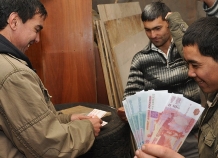
DUSHANBE, October 23, 2015, Asia-Plus — With an influx of refugees and migrants making headlines in Europe and politicians around the world debating the merits of immigration, it’s important to take a step back and consider the development impact migration has for both sending countries and host nations.
International labor migration has become a key driver of development around the world. One way migration impacts development is through the accompanying remittances, the money sent by migrant workers (and diasporas) to relatives back home.
Migrant remittances remain a significant force for development and a lifeline for many families in Central Asia.
A new UNDP report,
Labor Migration, Remittances, and Human Development in Central Asia
, notes that relative to GDP, remittances flowing into the less wealthy Central Asian countries are among the largest in the world. Tajikistan and Kyrgyzstan have been world leaders in this category since 2011.
These flows don’t just support the economy. They lift millions of people out of poverty.
In Kyrgyzstan for example, remittance inflows reduced the number of people living below the poverty line by 5 to 7 percentage points annually from 2010 to 2014. That’s about 300,000 to 400,000 men, women, and children.
The report reveals that migration and remittance flows have dropped since 2014. The declines, according to the study, have been due in large part to the economic slowdown in Russia and Kazakhstan, as well as tighter implementation of migration regulations in Russia.
Should these trends continue, they could have major development implications.
Using GDP forecasts provided by the International Monetary Fund (IMF) and labor force forecasts provided by the UN Department of Economic and Social Affairs (UNDESA), the study finds that—even in the minimalist scenario—migration outflows (and remittance inflows) for the next 15 years will continue to be quite significant in Tajikistan, Kyrgyzstan and Uzbekistan.
This is because the numbers of workers entering the labor force in the less wealthy Central Asian countries are likely to continue to dramatically exceed their economies’ ability to absorb them.
Meanwhile, a contracting labor force in Russia, combined with income levels at least three times as high as in Tajikistan and Kyrgyzstan, seem poised to attract growing numbers of jobless workers.
In other words, like many other places in the world, the push and pull factors behind migration will continue to inspire people to leave their home countries in search of opportunity.
We will recall that according to Russian central bank, remittance flows from Russia to Tajikistan in the first half-year of 2015, have reportedly declined by 58.6 percent compared to same period last year.
Only 696 million U.S. dollars have reportedly been sent through money transfer system to Tajikistan from the Russian Federation over the first six months of this year, which was 972 million U.S. dollars fewer than in the same period last year (1.668 billion U.S. dollars).
Meanwhile, the National Bank of Tajikistan (NBT) has earlier noted that 1.162 billion U.S. dollars have been remitted to banks in the country over the first six months of this year, which was 32 percent fewer than in the same period last year.
We will recall that 3.831 billion U.S. dollars (USD) were sent through money transfer system to Tajikistan from the Russian Federation last year, which was 324 million USD, or almost 8 percent, fewer compared to 2013.
Last year’s remittance flows to Tajikistan were estimated to account for 45 percent of country’s gross domestic product, which stood at 45.6 billion somoni (equivalent to 8.6 billion USD) in 2014.