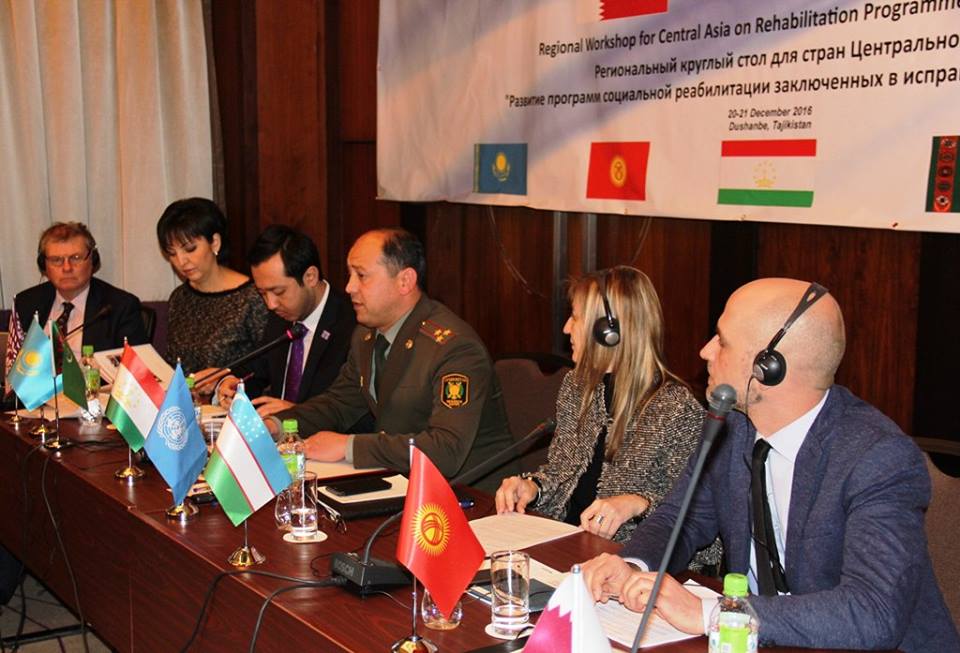
A two-day regional workshop to discuss the importance of rehabilitation programs in prison is concluding in Dushanbe today.
Convened by the UN Office on Drugs and Crime (UNODC) in cooperation with Penal reform International (PRI), the event reported brought together more than 50 policy-makers, justice professionals and other experts from around Central Asia.
The workshop participants are discussing promising practices and existing challenges related to the management of prison-based rehabilitation programs.
They, in particular, emphasized the need to strengthen education, vocational training and work programs in prisons in line with international standards and norms.
“Prison-based rehabilitation programs are essential for supporting successful reintegration of prisoners upon release. Therefore, the Government of Tajikistan endorsed the National Program on Development of Income Generating Activities in prisons of Tajikistan for 2015-2020. The Government of Tajikistan allocated funds for implementation of this Program and expressed interest in strengthening cooperation with international partners to attract additional funding” – said Mr. Ilhom Mahmoudzoda, Deputy Chairperson of the Central Prison Service under the Ministry of Justice of Tajikistan.
“The work towards the social reintegration of prisoners is indeed one of the principle objectives of UNODC in the area of prison reform. Its positive impact – both on individuals as well as with regards to public safety – should not be underestimated,” said Ms. Amelia Hannaford, Head of UNODC Office in Tajikistan.
She further pledged continued reflection of this objective in UNODC Program for Central Asia 2015-2019.
The regional workshop in Dushanbe is to be followed by similar conferences in different regions of the world, which will serve as a strong basis for developing concrete initiatives for the social reintegration of prisoners, and for technical support of UNODC in realizing these.
According to the United Nations Standard Minimum Rules for the Treatment of Prisoners (the Nelson Mandela Rules), the primary purposes of a sentence of imprisonment – namely, the protection of society from crime and the prevention of recidivism – can only be met if the period of imprisonment is used to assist prisoners in leading law-abiding and self-supporting lives upon release.
One of the principle objectives of the United Nations in the area of prison reform is to contribute to the successful reintegration of prisoners into society following their release. Social reintegration initiatives should start as early as possible within the criminal justice process in order to have maximum effect. This means that diversion from the criminal justice process (especially of vulnerable groups) to appropriate treatment programs, non-custodial sanctions, instead of isolation from society and purposeful activities and programs in prisons, can all be considered as elements of a comprehensive “social reintegration” policy. Interventions to support former prisoners following release from prison, continuum of care in the community for those in need, will all be more effective if the period in prison is used to prepare a prisoner for re-entry to society. This policy requires close coordination between criminal justice institutions and social protection and health services in the community and probation services where they exist. UNODC can offer key support and advice in this area, including supporting the development of social reintegration programs in prisons and in assisting with the planning and implementation of continuum of care and support in the community.