
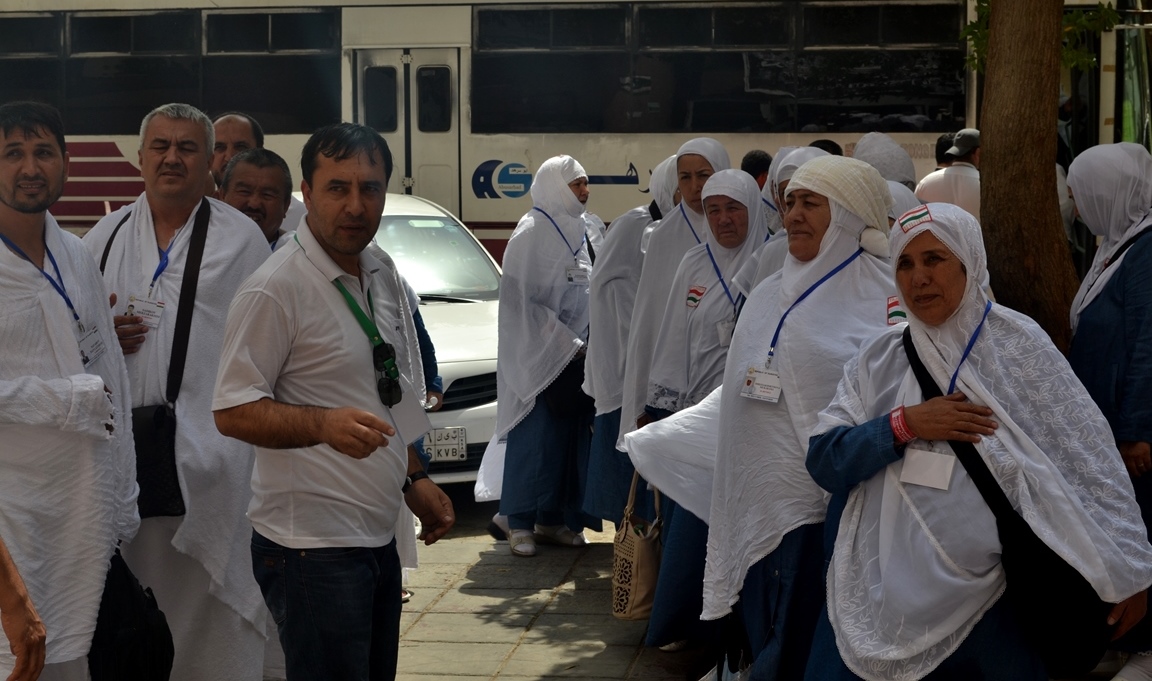
Saudi Arabia has approved Hajj quota for Tajikistan, and like the previous year, 6,000 Muslims from Tajikistan will perform the Hajj this year.
The Committee for Religious Affairs (CRA) under the Government of Tajikistan is continuing to receive Hajj applications.
Recall, Tajik authorities last year introduced new age restrictions for those who want to perform the Hajj. Citizens under the age of 40 are no longer allowed to perform the Hajj. The aim of the decision to introduce new age restrictions is reportedly to give older people an opportunity to achieve their dream to perform the Hajj.
The new age limit of 40 has been raised from the limit of 35 that was instituted in April 2015.
For the first time the CRA introduced age restrictions on those who want to perform the Hajj in 2010. Only citizens aged 18 to 80 were able to perform the Hajj.
In 2011, the CRA designed a new Hajj uniform; men don two-piece suits, while women wear long-sleeved dresses complete with headscarves. The Tajik Hajj uniform is embroidered with the country’s symbols.
Last year, Tajik pilgrims had to pay 3,600 U.S. dollars each for the Hajj this year. This amount included travel expenses, board and lodging, special clothing with the national flag, purchase of animal for sacrificing, guide services, medical insurance, vaccinations, etc.
“The Hajj cost for this year has not yet been determined. Anyway, it will be higher than last year because of increase in the exchange rate of the dollar against the Tajik national currency, the somoni,” a source at CRA told Asia-Plus in an interview.
Each year, Saudi Arabia welcomes millions of Muslims from abroad traveling on Umrah and Hajj. Hajj, one of the five pillars of Islam, is a pilgrimage to Mecca which adult Muslims must make at least one in their lifetime, provided they are physically and financially able. The Hajj is a demonstration of the solidarity of the Muslim people, and their submission to God. The pilgrimage occurs from the 8th to 12th day of Dhu al-Hijjah, the 12th and last month of the Islamic calendar. Because the Islamic calendar is a lunar calendar, eleven days shorter than the Gregorian calendar, the Gregorian date of the Hajj changes from year to year. This year the Hajj will fall between August 30, 2017 and September 4, 2017.
