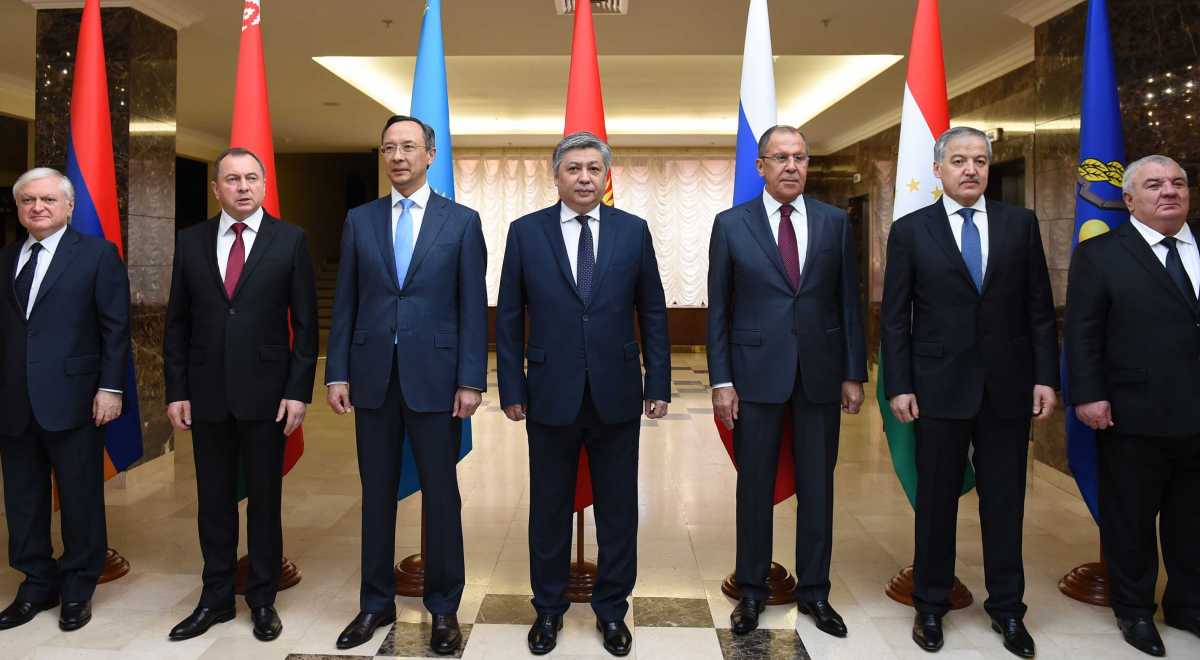
A regular meeting of the Collective Security Treaty Organization (CSTO) Council of Foreign Ministers took place in the Kazakh city of Almaty on June 11.
The meeting’s agenda reportedly included 12 items. According to Kazinform, a Kazakh state-run news agency, the ministers discussed issues of foreign policy coordination within the Organization, topical issues of international and regional security.
The parties also exchanged views on countering contemporary trans-border threat and challenges and some other issues being of mutual interest.
The CSTO foreign ministers are concerned about the situation in northern Afghanistan where the Islamic State (IS) terror group is establishing a bridgehead, Russia’s Foreign Minister Sergey Lavrov said following the meeting of CSTO foreign ministers on Monday, according to RIA Novosti.
“All ministers spoke about the need to stabilize the situation [in Afghanistan]. They voiced concern that the IS militants are tapping into the country, particularly from Syria and Iraq. They were particularly concerned about the fact that terrorists are beginning to establish a bridgehead in the northern provinces of Afghanistan, meaning in immediate proximity to the CSTO’s area of responsibility,” Russian minister noted.
According to Lavrov, the CSTO member nations will continue coordinating actions, including assistance provided to Tajikistan to reinforce its national border with Afghanistan. “All actions implied through defense ministries, special services, interior ministries, border troops, including the operation on drug interdiction named ‘Channel’, will continue. Respective agreements remain in force, which was clearly confirmed today," the minister explained.
According to TASS, Lavrov noted that the NATO mission in Afghanistan “is not always acting transparently.” “There have been several cases when governors of provinces made statements on certain unmarked helicopters heading to the region where terrorists were deployed. Taking into account the fact that NATO forces and the US control all air space above Afghanistan, they at least could not have been unaware of it,” Russia’s top diplomat added.
The CSTO Foreign Ministers Council is a charter body of the organization which holds sessions twice a year: in the run-up to a session of the Collective Security Treaty Organization (the end of the calendar year) and in between sessions (second quarter). The meeting of the council in between sessions is organized in the state which holds the CSTO chairmanship.
The regional security organization was initially set up in 1992 in a meeting in Tashkent and Uzbekistan once already suspended its membership in 1999. However, Tashkent returned to the CSTO again in 2006 The regional security organization was initially formed in 1992 for a five-year period by the members of the CIS Collective Security Treaty (CST) — Armenia, Kazakhstan, Kyrgyzstan, Russia, Tajikistan, and Uzbekistan, which were joined by Azerbaijan, Georgia, and Belarus the following year. A 1994 treaty reaffirmed the desire of all participating states to abstain from the use or threat of force, and prevented signatories from joining any “other military alliances or other groups of states” directed against members states. The CST was then extended for another five-year term in April 1999, and was signed by the presidents of Armenia, Belarus, Kazakhstan, Kyrgyzstan, Russia, and Tajikistan. In October 2002, the group was renamed as the CSTO. Uzbekistan that suspended its membership in 1999 returned to the CSTO again in 2006 after it came under international criticism for its brutal crackdown of antigovernment demonstrations in the eastern city of Andijon in May 2005. On June 28, 2012, Uzbekistan announced that it has suspended its membership of the CSTO, saying the organization ignores Uzbekistan and does not consider its views. The CSTO is currently an observer organization at the United Nations General Assembly.