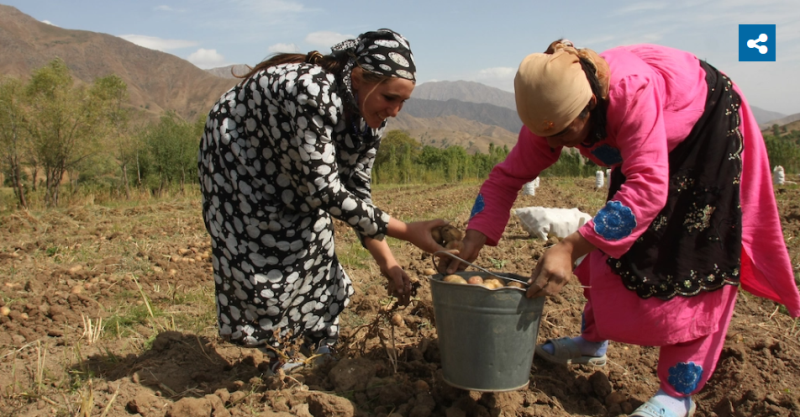
Central and West Asia, and its neighboring countries, must work together to address increasingly severe impacts of climate change that could lead to water scarcity, food insecurity, and even conflict in the region, the Asian Development Bank (ADB) said on May 5.
“The recent, intense weather events in Central and West Asia show that we need to take urgent, collective action,” said ADB Director General for Central and West Asia Yevgeniy Zhukov. “Countries in the region must work together to cut greenhouse gas emissions, ramp up climate resilience, and manage precious, shared natural resources for the good of all.”
Mr. Zhukov made the statement at ADB's 56th Annual Meeting where he launched CAREC 2030: Supporting Regional Actions to Address Climate Change, a scoping study on climate challenges and opportunities in member countries of the Central Asia Regional Economic Cooperation (CAREC) Program.
Climate change is expected to have severe impacts in the CAREC region which includes Central Asia, Mongolia, Pakistan, the People’s Republic of China, and the South Caucasus. Higher-than-average temperature rises are likely to lead to greater water scarcity, expanded desertification, and more extreme weather events like floods and droughts, according to the study.
In Central Asia, a water supply gap of 37% will occur by 2050 unless irrigation systems and other critical water infrastructure are upgraded and modernized. This gap could lead to lower agricultural productivity, more food insecurity, worse health outcomes—and potential conflicts over scarce resources.
The study recommends that the CAREC Program should develop a climate change strategy defining priority sectors for collaboration, outline projects with the most mitigation- and adaptation-potential and propose a facility to finance those projects. Publicizing a common position among CAREC members at global climate negotiations such as COP, will also strengthen the region’s collective call for climate action, according to the study.
CAREC is a partnership of countries and development partners working together to promote sustainable development through cooperation. ADB hosts the CAREC secretariat and helps to facilitate projects that deliver regional benefits. Around $50 billion has been invested in CAREC-related projects since inception in 2001.
As Asia and the Pacific’s climate bank, ADB aims to deliver $100 billion in climate financing from 2019 to 2030. This week, ADB launched the Innovative Finance Facility for Climate in Asia and the Pacific (IF-CAP), which will use guarantees from partners as leverage to accelerate billions of dollars in much-needed climate investment.
Established in 1966, the Asian Development Bank is owned by 68 members—49 from the region.
ADB has partnered with Tajikistan since 1998. Under the bank’s country partnership strategy, 2021-2025, ADB operations pursue three strategic priorities: supporting structural reforms to enhance resource allocation and mobilization, improving labor productivity through human capital development, and fostering better livelihoods through investment in a land-linked economy. To date, ADB has committed 155 public sector loans, grants, and technical assistance totaling US$2.4 billion to Tajikistan.