It is difficult for women in Tajikistan to break gender stereotypes and earn on a par with men. The more valuable is the experience and aspiration of those of them who are not afraid to challenge the patriarchal society and, overcoming stereotypes, establish themselves in non-traditional professions for women.
Tajikistan is considered a country with a high level of poverty due to the fact that not only women but also men find it difficult to find work in the country. According to the World Bank, because of this, every fourth citizen of the country goes to work in labor migration, mainly to Russia.
According to the World Bank’s Gender Development Index, women in Tajikistan are more likely to be unemployed than men – 69 percent of working-age women are unemployed compared to 49 percent of men.
CABAR.asia says Mavzuna Sanginova from the Tajik northern city of Khujand spent eight years of her life in labor migration in Russia. There she worked as a laborer, doing hard work on construction sites along with men. But after returning home, she decided to learn a “man’s” profession, bringing daily income to her family.
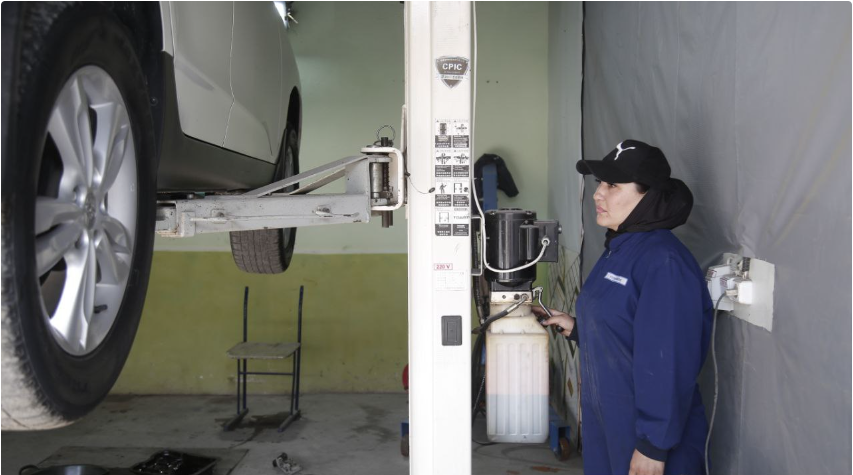
Today Mavzuna is known as Usto (master) Mavzuna in Khujand and beyond. The drivers, her clients, whom she has been fixing cars for a year, have given her this name. She works as a car mechanic, a profession most often attributed to men in Tajik society.
For Mavzuna, 30, locksmithing is not just a hobby but a necessity in life. She was 18 when she married. From the first days of married life, she and her husband lived in a rented apartment, and in Tajikistan, everyone wants to have their own place. There was not enough money, so she and her husband had to go to work in Russia, in labor migration.
She says that in labor migration, too, she was mostly engaged in “male” occupations. By the time she returned to Khujand in 2020, Mavzuna already had two young children. That’s when she decided that in order to realize her childhood dreams, she needed to get a specialty.
When she came to apply to Vocational School No. 44 in Khujand, she was offered courses in sewing and design. But she dreamed of becoming a car mechanic. Her father, who had worked as a car mechanic all his life, was an example to her.
A young woman was in a group with 29 young men. This was the first time in the history of the college. According to Mavzuna, no one believed she would stay true to her chosen profession. But after a year of apprenticeship training, Mavzuna’s male classmates were now learning the finer points of the craft.
With the support of her professors, she wrote a project and submitted it for a presidential grant. The committee accepted her project and she got a grant of 40,000 somonis (about US$4,000) to buy modern equipment and set up a workshop. June 6, 2022, was her first day of work in that workshop.
Mavzuna’s workshop is located in a row of workshops where only men work. However, Mavzuna has managed to build up her own customer base, and her reputation as a good mechanic has spread beyond Khujand. Male drivers treat the woman’s master with respect.
In just one year of activity in her workshop, Mavzuna has already taught the profession to seven young men, who have continued this work in labor migration. Currently, three girls have signed up to learn the nuances of motor mechanics as apprentices at Mavzuna.
In the future, Usto Mavzuna plans to expand her workshop and train other women and girls in her profession. She dreams of setting up a large workshop where only women would repair cars and make a living at it.