

The Aga Khan Development Network (AKDN) says the Aga Khan Foundation (AKF) works in partnership with the Government of Tajikistan, international community and local private sector to build a more prosperous Tajikistan for all.
Agriculture reportedly comprises over 22 percent of Tajikistan’s GDP, and AKF helps farmers and micro- to medium-sized companies to increase their productivity, expand their reach beyond the borders of Tajikistan and create jobs for the population.
AKF works with producer groups to form clusters. These enable them to collaborate and learn from each other to improve their agriculture production, marketing and distribution, reaching larger markets. AKF also supports farmers to increase their financial literacy and remove barriers to accessing finance.
The AKF-initiated Mountain Societies Development Support Programme (MSDSP) engages communities in projects which create opportunities for increased income and improve community access to quality education, health and agriculture. MSDSP, in particular, organized training for farmers in Zarafshon Valley of Sughd province.
Thus, 60-year-old Mirzo Hikmatov, of Veshab village, Ayni district, Sughd province, was a farmer but has been beekeeping since 2005, when he realized he could make a good salary through an activity he loves. He has 20 bee hives, which in 2022 gave him 500 kg of honey. Hikmatov attended MSDSP seminars on how to keep bees during the winter season, increase production and market his honey. During the training, he attended exhibitions in Dushanbe and Khujand, connecting with two new buyers.
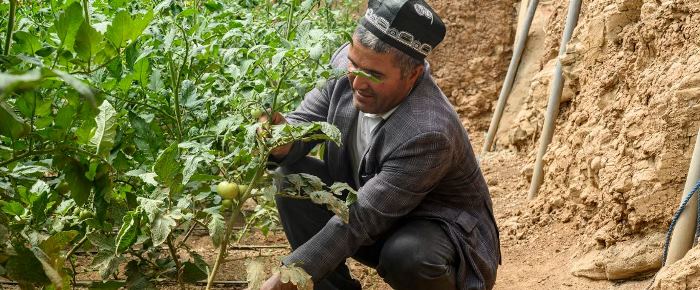
Junaidullo Khushvaqtov from Pushti Qurghon village in Panjakent, Sughd province learned to farm from his father, and grows potatoes, carrots, fruit and more to sell to local markets. He reportedly attended training through MSDSP in 2018, where he was advised to buy a greenhouse. Now he can grow tomatoes in any weather, previously too risky a crop in this mountainous part of Tajikistan.
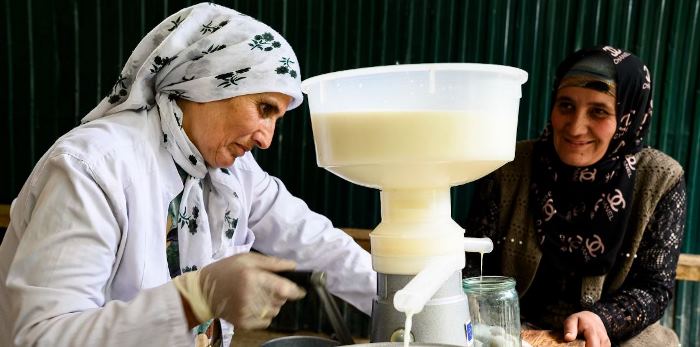
In 2017, AKF encouraged women in Ayni district in Sughd province making dairy products to form a cluster. Ten women joined the Iftikhor women's group. They received a separator, to separate milk from butter. The cluster now has 25 members, aged from 40-60. Together they plan to buy other breeds of cows, which produce more milk, to increase the scale of production.
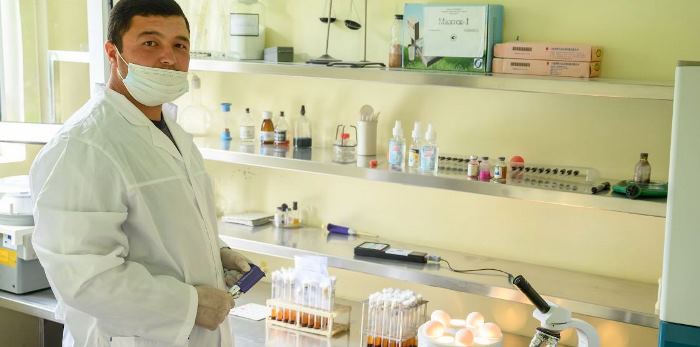
Like the Iftikhor group, many farmers in Ayni district, Sughd rely on their livestock to provide dairy products and meat throughout the year. However, the lack of diagnostic and preventive measures against brucellosis, which affects the animals and can cause endocarditis or meningitis in humans, was resulting in the spread of infection and economic loss. Testing was only available three hours drive away, in Panjakent.
In 2017, an AKF/European Commission program, Improving Livelihoods and Food Security through Sustainable Natural Resources Management, established a livestock laboratory in Ayni. There are eight vets, one per jamoat (rural municipality), who collect the blood of the livestock from Ayni district and bring it here for the test.
The laboratory is equipped to detect zoonotic diseases in cattle, goats and sheep, and has a microscope, fridge, incubator and ovoscope to test egg quality. Between January and May 2023, before the livestock were moved to the mountains for the summer, the staff ran 5,000 analyses of cattle and nearly 3,400 analyses of sheep.



