
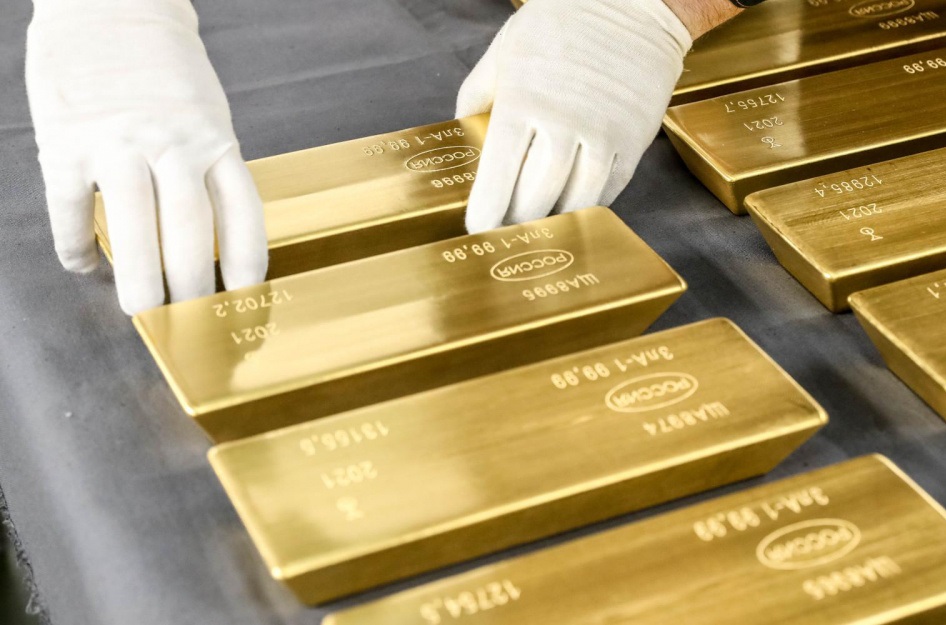
In 2025, the price of gold bars issued by the National Bank of Tajikistan (NBT) surged by a record 39.03%, driven by the global rise in gold prices. However, in the first five days of 2026, gold prices have continued to rise at an even faster pace — an average of 3%. This seems to be linked to the accelerated rise in global precious metal prices, influenced by developments in Venezuela.
As it had been reported earlier, a record increase of 43% was reported in 2020 during the pandemic, but the next two years saw slight decreases of 4.1% in 2021 and 9.0% in 2022. In 2023, the price rose by 21.5%, and in 2024 by 25.8%.
According to NBT, the price of a 5-gram gold bar increased by 1,832.19 somonis over the past year, reaching 6,610.42 somonis as of January 1, 2026.
Meanwhile, the cost of a 100-gram bar rose by 36,737.98 somonis (39.47%), with price of 129,812.90 somonis on the same date.
Tajikistan’s central bank also offers measured gold bars weighing 10, 20, and 50 grams.
As of January 1, 2026, the selling prices for these gold bars reached 13,506.42, 26,879.42 and 66,981.47, respectively.
The 5-, 10-, 20-, 50- and 100 gram gold bars produced by the National Bank of Tajikistan were released into free circulation in June 2017. The gold bars are sold by the NBT Department of Monetary Circulation and Cash Operations.
The then-head of the NBT Jamshed Nourmahmadzoda told reporters in Dushanbe on February 5, 2020 that gold bars with a total weight of 100 kilograms are waiting for their customers in storage of Tajik central bank.
“By president’s order we have produced gold bars with a total weight of 100 kilograms and we are gradually selling them,” Nourmahmadzoda noted.
According to him, citizens of the country can buy the NBT-produced bars using their passports. “No other documents are required,” Nourmahmadzoda said.
Each citizen of Tajikistan can buy gold bars totally weighing one kilogram per year.
Investor Activity in Gold
Several factors contributed to this increase: geopolitical tensions, the weakening of the U.S. dollar, and a growing demand for gold.
Investor interest has also been strong in exchange-traded funds (ETFs), with approximately $77 billion invested in gold since the beginning of 2025, and gold reserves increased by more than 700 tons by the end of November. This highlights the strengthening of gold as one of the key "safe-haven" assets in times of uncertainty.
As of January 5, 2026, the price of gold on the LBM (London Gold Fixing) market stood at $4,436.70 per troy ounce (31.1 grams). At the beginning of 2025, the price was $2,646.30, marking a 67.7% increase over the year.
Outlook for 2026
According to analyst Gayane Zamaliyeva, gold is likely to retain its status as one of the key defensive assets in 2026. However, she predicts more moderate and uneven dynamics compared to the rally in the second half of 2025: "The dynamics will be more restrained and uneven," she said.
Yelena Kozukhova, an analyst at VELES Capital, believes that the increasingly tense global situation will support gold prices in 2026. "The ongoing Ukrainian conflict, the escalation of relations between the U.S. and Venezuela, potential Israeli strikes on Iran, and tensions in Asia remain key factors," she adds.
Nikolai Dudchenko from Finam notes that when the dollar falls, prices for safe-haven assets like gold tend to rise. He predicts that the Federal Reserve may cut interest rates in 2026, which will weaken the dollar and support gold and other commodities.
Gold as a diversification tool
Dudchenko emphasizes that gold remains one of the best tools for diversifying investment portfolios, due to its lack of default risk and its ability to hedge against inflation. "This is especially relevant in light of recent economic decisions, such as the passage of the 'Big Beautiful Bill' in the U.S., which may significantly increase the U.S. budget deficit," he said.
Ludmila Rokotyanskaya, an expert from BCS Mir Investments, points to the holiday season in the U.S., India, and China at the beginning of 2026, when demand for gold from the jewelry industry will increase, further driving up its price. "Additionally, annual gold supply is limited and usually cannot keep up with the sharp rise in demand," she notes.
