
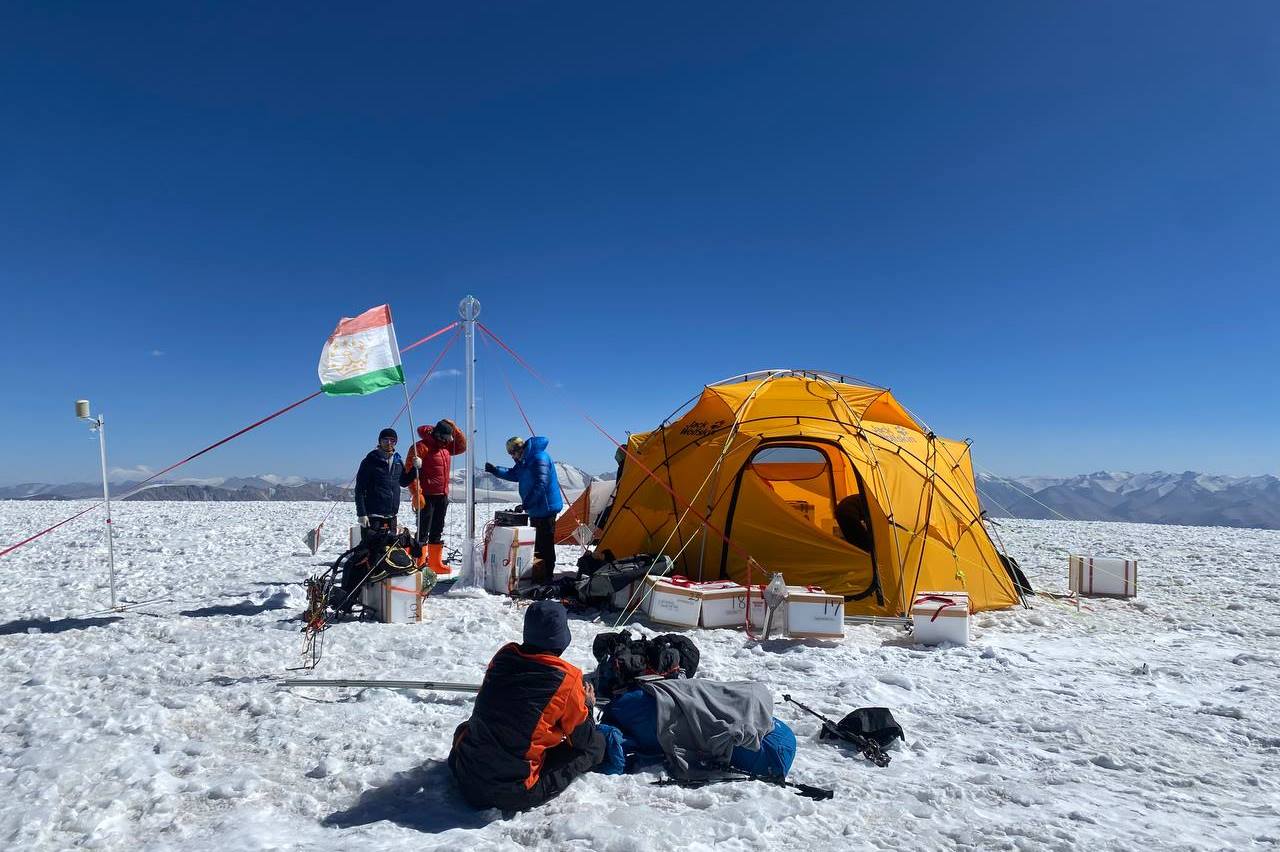
This autumn, an international scientific expedition in Tajikistan concluded its work in the Murgab district of the Gorno-Badakhshan Autonomous Region (GBAO), a study that has already been hailed as one of the most significant for understanding the glaciers of the region.
The focus of the research was Glacier No. 3 in the Khovar-Kul basin, known today as Qal’ai Kabud (Blue Fortress). Previously, this glacier was referred to as the ice cap of Kon-Chukurbashi, formed on the peak of the same name, which rises 5,811 meters above sea level.
The expedition took place in harsh high-altitude conditions, ranging from 4,200 meters to nearly 5,800 meters. Even in September and October, temperatures here can drop to -10 to -15 degrees Celsius, while strong winds and the thin air make any work physically challenging.
Nazrialo Sheralizoda, Director of the Center for Glacier Studies at the National Academy of Sciences of Tajikistan, explained that the choice of this glacier was deliberate. “Our key task was to find a glacier least affected by degradation. Only in such conditions can we obtain the most accurate and reliable climate data from the past,” he said.
According to Sheralizoda, based on long-term observations and previous expeditions, Glacier No. 3 in the Khovar-Kul basin was found to be the most suitable for drilling operations. “Located at altitudes from 5,100 to 5,811 meters, this glacier has relatively slow melting rates and is even in a phase of relative growth. This rare phenomenon is part of what’s known as the 'Pamir-Karakoram anomaly,'” he noted.
The expedition included around 20 researchers from Tajikistan, Russia, China, Switzerland, Japan, France, Germany, Canada, the United States, and other countries. The main fieldwork took place from mid-September to early October 2025.
30,000 years of climate data
Jovidon Davlatov, a junior researcher at the Center for Glacier Studies, recalls the difficult journey to the research site. "The expedition started on September 15. From the village of Khovarkul (formerly called Karakul) to the base camp was about 35 kilometers. The camp was located at 4,200 meters above sea level, where we prepared for the main work. The peak of Qal’ai Kabud (formerly Chukur-Konbashi) reaches nearly 5,800 meters. It’s situated on the Sarykol Range, close to the border with China," he shared.
All the equipment, including drilling rigs, tools, and ice storage containers, had to be manually transported by the team. "The weather was harsh. In the camp, it was -10°C, and on the peak, it was -15°C, with constant winds. Drilling under these conditions was extremely difficult. We worked for five days straight," Davlatov added.
As a result, two boreholes were drilled, each more than 110 meters deep, extracting ice cores — cylinders of ice containing vital data on atmospheric composition, precipitation, and climate from past millennia.
“These samples are of exceptional scientific value,” Sheralizoda emphasized. "They allow us to reconstruct climate changes, including periods of cooling and sharp climate fluctuations, and to understand how the cryosphere developed in high-altitude conditions."
Laboratory analysis of these cores will help scientists predict the future of glaciers and assess risks to the region’s water resources. The data will also serve as a foundation for developing measures to adapt to climate change and ensure water security.
Researchers have previously reported that the Kon-Chukurbashi ice cap is a rare natural anomaly. Despite global warming, this glacier continues to grow, while most glaciers worldwide are rapidly shrinking. Studies suggest that the extracted ice cores may contain up to 30,000 years of climate data.
One of the samples was sent to the Low Temperature Research Institute at Hokkaido University in Japan for analysis, aimed at understanding the glacier’s stability. Another core was transferred to the Ice Memory international foundation and sent for long-term storage in Antarctica, as Tajikistan's contribution to preserving the planet's "climate memory."
The secrets of the Blue Fortress Glacier: How the Pamirs help us understand climate change
What about other glaciers?
The results of the expedition have been highly praised by international partners, who commended the professionalism of Tajik scientists, strict adherence to international field research standards, and the complexity of the work conducted in extreme high-altitude conditions.
"The work done on the Khovar-Kul glacier clearly demonstrates that Tajikistan is not just participating, but taking an active role in global cryosphere research," Sheralizoda emphasized.
Discussing the situation in the region more broadly, Khusrav Kabutov, Head of the Glaciology and Glacier Monitoring Department, noted that the Qal'ai Kabud glacier is an exception rather than the rule for the Khovar-Kul basin.
"In the Khovar-Kul basin, the picture is uneven. Some glaciers are relatively stable, but most are shrinking. We observe particularly significant changes in a number of smaller and medium-sized glaciers," he explained.
Kabutov also pointed out that the most concerning situation is with the Zulmart glacier, which also belongs to the Khovar-Kul basin. "Our observations show that the melting rate of the Zulmart glacier has increased approximately tenfold in recent years. This is a very serious indicator. The glacier is rapidly losing mass, its structure is changing, and its area is shrinking," he noted.
He explained that these processes are directly linked to changing climate conditions — rising average annual temperatures and shifts in precipitation patterns.
Against this backdrop, the resilience of the Qal’ai Kabud glacier is of particular scientific interest.
