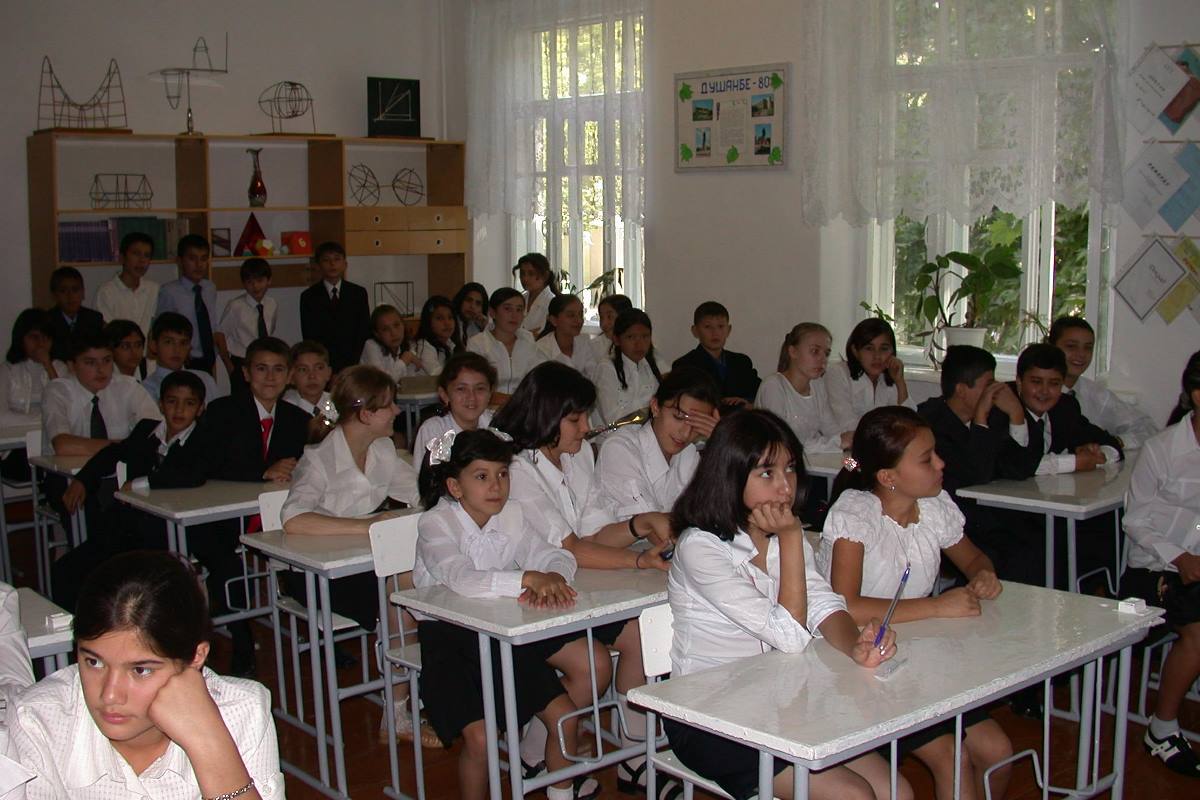
Every third school student in Tajikistan earns “good” or “excellent” grades, according to inspections conducted by the Agency for Supervision in Education in 408 schools. The overall achievement rate, which also includes passing grades, reaches nearly 80%.
On paper, the picture appears relatively positive: most students are deemed to have “mastered the curriculum.” But a key question remains — what do these grades actually represent, and can they truly reflect the quality of education?
What school performance really depends on
Sociologist Gulnora Beknazarova emphasizes that academic performance cannot be separated from the conditions in which a child lives. Learning outcomes are shaped by region, infrastructure, and whether schools are adequately staffed.
Family resources also matter — the ability to provide school supplies, transportation, warm clothing, and proper nutrition. Equally important is parents’ cultural capital: their capacity to support learning, help with homework, and engage with teachers.
Language of instruction is another critical factor. When the school language differs from the language spoken at home, children — especially in primary grades — face additional barriers to learning.
Family dynamics and social status also play a role.
“If a child has to care for younger siblings, lives in a disadvantaged household, or lacks proper nutrition, this directly affects academic results,” the expert notes.
Extracurricular opportunities such as libraries, clubs, and competitions can motivate students, while gender norms in Tajikistan continue to influence boys’ and girls’ educational paths differently.
Labor migration is a particularly sensitive issue.
“When parents are absent or overworked, supervision weakens and responsibility shifts to children. This is especially evident when mothers combine paid work with all household duties,” Beknazarova explains.
Low academic performance, she stresses, is not about a “bad student” or a “weak teacher,” but a signal of systemic problems at the intersection of school, family, economy, and social environment.
“Grades alone cannot measure education quality”
Veteran teacher Nargis Qurbonova, with 30 years of experience, says schools — and children — have changed dramatically. Discipline once relied on obedience; today students increasingly ask “why?”
This does not indicate laziness or disrespect, she says, but reflects a new reality in which schools are no longer unquestioned authorities. In the past, there were more top students — but also more children who were simply pushed out of the system. Today, schools try to retain students even when learning is difficult.
In her fourth-grade graduating class of around 50 students, about 20% are top performers, 40% are solid achievers, and another 40% have basic proficiency.
“There is no longer a systemic category of ‘failing students.’ A ‘C’ grade in primary school is not a verdict. Many children study in a non-native language, and progress matters more than the mark itself,” she says.
Poor performance rarely has a single cause. Overloaded curricula, unequal starting points, teacher burnout, and large class sizes all contribute. Even the shift to a 10-point grading scale, while helpful, does not fully reflect real learning.
“A grade is just a snapshot of one day. Skills like critical thinking, reasoning, and reading comprehension don’t fit neatly into numbers,” Qurbonova explains.
When the system fails remote schools
Education challenges are even more visible in the regions. An educator from Khorog with long experience in Gorno-Badakhshan Autonomous Region (GBAO) says formal oversight often fails due to lack of resources.
Inspectors cannot regularly reach remote schools, leaving real conditions outside official statistics. Shortages of modern textbooks and outdated curricula remain serious problems.
Teacher training is another weak point. Although courses formally exist, schools and local authorities often lack funds to send teachers for professional development.
There is also internal pressure within schools.
“If a teacher gives too many low grades, they are told they’re doing a bad job. As a result, grades are inflated for the sake of reporting,” the expert says.
Assessment standards also vary widely, making official figures unreliable.
“These percentages are very conditional. In reality, the situation may be far worse,” he admits.
How grades shape a child’s self-esteem
Clinical psychologist and neuropsychologist Nigor Abdughaffor notes that for children, grades are closely tied to self-perception.
“Children often can’t separate ‘I did poorly on a test’ from ‘I am bad,’” she explains.
Low grades can trigger anxiety, fear of school, and avoidance behaviors, eventually undermining motivation. One of the most serious outcomes is “learned helplessness” — when a child stops believing effort can change anything. This mindset often carries into adulthood.
At the same time, excessively high grades can also be harmful.
“They create conditional self-worth: I am valued only if I perform perfectly,” she says.
According to Abdughaffor, the education system remains focused on results and rankings rather than development. She contrasts this with Western practices where mistakes are allowed and corrected without fear.
“In a healthy system, grades provide feedback — what worked and how to improve. In an unhealthy one, grades answer the question ‘Who am I?’ And that’s where many problems begin,” she concludes.