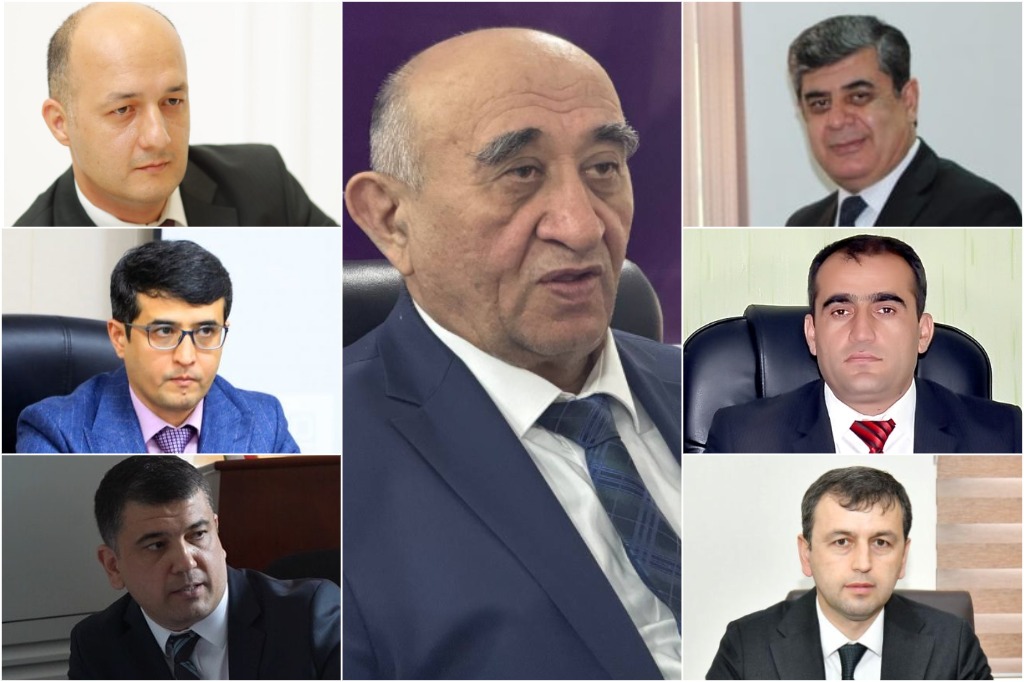
President of Tajikistan, Emomali Rahmon, who is also the Head of Government, has made several personnel changes in the leadership of key oversight, law enforcement, and other government agencies. The president’s official website says that according to decrees and resolutions signed on February 25, leadership shifts occurred in the Ministry of Justice, Ministry of Culture, the Agency for State Financial Control and Combating Corruption, the Accounts Chamber, as well as in the Prosecutor-General’s Office, security agencies, and other bodies.
In a move decided by the head of government, San'at Aso Rahim was relieved from his position as head of the State Service for Industrial Safety and Mining Supervision and has been retired. He had held the role since 2015. Rahim previously served as the CEO of JSC Hydrospecstroy, head of the hydropower project implementation group, director of the Roghun Hydroelectric Construction Directorate, head of the state energy company Barqi Tojik, and director of infrastructure development at the Executive Office of the President of Tajikistan.
His successor is Ismoil Sulton Valizoda, who had previously served as the deputy head of the Republic’s Main Geology Directorate.
Asadullo Hakimzoda has been relieved of his duties as deputy minister of justice and appointed as the first deputy minister of justice. Notably, in January, Nigina Alizoda was moved from her role as first deputy minister of justice to become deputy minister of foreign affairs.
Sharofiddin Sharifzoda has been appointed as deputy minister of justice in place of Hakimzoda. Prior to this, Sharifzoda was the state notary at the Ministry of Justice’s Main Notary Directorate.
Faridoun Bobozoda, who had previously worked as deputy head of the Education, Culture, and Information Directorate at President’s Executive Office, has been appointed as deputy minister of culture. He succeeds Manouchehr Sharifzoda, who was appointed head of the National Theater.
By president’s decree, Soleh Zavqizoda has been relieved of his position as director of the Judges' Training Center under the Supreme Court, following his retirement. His replacement is Asomuddin Bobokhonzoda, who was previously a judge at the Supreme Court.
Baqokhoja Bobozoda has been relieved of his role as director of the Institute of Botany, Physiology, and Plant Genetics at the National Academy of Sciences of Tajikistan, due to a job change. The new appointee for this position has yet to be announced.
Additionally, President Rahmon has sent proposals to parliament to relieve Shuhrat Ahmadzoda from his role as the Chief Auditor of the Accounts Chamber of Tajikistan and appoint him as deputy chair of the chamber. Parviz Mahmadsharifzoda has been nominated to replace Ahmadzoda.
By agreement with Rahmon, several leadership changes were made in the Prosecutor-General’s Office, as well as in the prosecutors' offices of the districts of Vanj, Murgab, Hamadoni, Khovaling, Bobojon-Ghafourov, Jabbor-Rasoulov, Kuhistoni Mastchoh, and the city of Buston. The names of the new appointees were not disclosed.
Furthermore, new leadership was appointed to several branches of the State Committee for National Security (SCNS) in various cities and districts across the country, as well as to management positions in the Agency for State Financial Control and Combating Corruption in the Kulob and Rasht zones.
In a conversation with the newly appointed officials, President Rahmon emphasized the need to accelerate digitalization efforts, promote cashless transactions, support national culture, combat superstitions and crime—including corruption and the illegal drug trade—ensure judicial fairness, uphold the rule of law, and maintain strong relationships with the people.