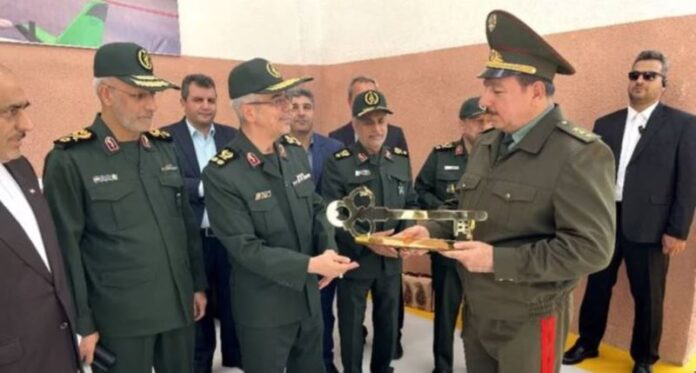
In May 2022, Iranian officials announced the opening of their first foreign drone production facility in Tajikistan. The factory was said to be producing Ababil 2 tactical reconnaissance drones, designed for short-range operations and priced lower than Iran's well-known Shahed drones. This factory, located near Dushanbe, was hailed as a major step in expanding Iran's military capabilities abroad.
At the time, Iranian Major-General Mohammad Bagheri, then head of Iran’s armed forces, expressed optimism about the project. “Today, we have reached a position where, apart from fulfilling domestic needs, we can export military equipment to allies and friendly countries to strengthen security,” he said at the opening ceremony.
Meanwhile, an article by Zamira Eshanova, a correspondent for RFE/RL's Uzbek Service, and Radio Liberty’s Tajik Service reported on March 31 that despite these claims, nearly four years later, there is no tangible evidence that the facility exists or produces drones, and no clear answers on its whereabouts or the fate of the drones have emerged.
Disappearance of the factory
Tajik authorities have remained silent on the matter, with inquiries from Radio Free Europe/Radio Liberty (RFE/RL) going unanswered by the Tajik ministries of Defense, Foreign Affairs, and Industry. However, two senior officials in Dushanbe, speaking anonymously, have privately insisted that no such facility exists.
"Creating a drone production facility is not like producing Pepsi-Cola. I am 1,000 percent sure that such a factory does not exist in Tajikistan. Absolutely no such factory," one official commented.
A Western diplomat stationed in Dushanbe echoed this sentiment, noting a lack of further reports or verification. "We heard about it once, but after that, nothing," the diplomat said. "If the factory existed, we would have certainly been notified or asked about it."
No trace in satellite imagery
Despite Iranian media reports claiming the factory was situated on the outskirts of Dushanbe, including near Ayni Airbase, which hosts both Tajik and Russian military assets, there is no publicly available evidence confirming its operation. Satellite and open-source intelligence (OSINT) experts, including Igor Semyvolos, director of the Center for Middle East Studies, reportedly argue that such a facility would have likely been detected through publicly available data by now.
Semyvolos speculated that Tajikistan may have reconsidered the project as it became politically sensitive. Cooperation with Iran, or even Russia, in military technology could invite international scrutiny, diplomatic pressure, or sanctions. As a result, the Tajik government might have quietly abandoned the plans.
Tajikistan’s official stance
In October 2022, Tajikistan's Ministry of Foreign Affairs issued a statement denying reports that drones produced in the country were being sent to Russia for use in Ukraine. While the statement did not confirm or deny the existence of the factory, it emphasized that Tajikistan does not export military equipment to third countries.
Semyvolos further pointed out that there have been no reports of Ababil 2 drones appearing in Ukraine, undermining the factory's purported significance. "We have not actually seen the Ababil 2 anywhere on the Russian-Ukrainian front," he said. "Assessing the production and operational status of this factory is extremely difficult."
A symbolic gesture?
Some analysts believe the 2022 inauguration may have been more about Iranian propaganda than a genuine military expansion. According to the article, Eric Lob, an associate professor at Florida International University, suggested that the publicized event could have been a symbolic move to counter Iran’s international isolation. "The pomp and circumstance of these meetings is a way for them to symbolically push back against isolation and signal that Iran has allies and partners," he said.
As of now, the fate of the alleged drone factory remains unclear, with no concrete evidence to support its existence or operations.