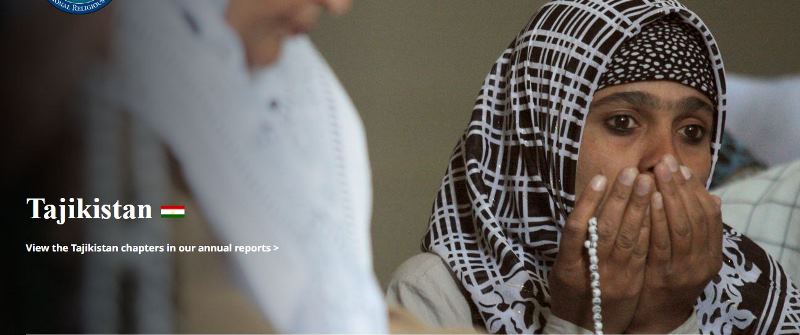
The government of Tajikistan has faced increasing international scrutiny over its treatment of religious minorities and its crackdown on religious freedoms. Despite the constitutional guarantee of the right to practice any religion or none, restrictions on religious practices, particularly Islam, have intensified in recent months, says the 2026 annual report released by the US Commission on International Religious Freedom (USCIRF).
In a move that has drawn concern from human rights organizations, Tajik authorities arrested 195 individuals suspected of involvement with extremist or terrorist groups in the first half of 2023. Among those affected were members of various religious groups, including Jehovah’s Witnesses, who have long been targeted by the government.
Elsewhere, authorities have reportedly focused their efforts on the Ismaili Shia community, particularly in the Gorno-Badakhshan Autonomous Region (GBAO). Authorities reportedly seized several properties associated with the Aga Khan.
In another troubling development, the Supreme Court ruled on June 14 that Pamir Daily News, an independent news outlet focusing on the GBAO region, was an “extremist organization” and banned its activities. This follows the Supreme Court's 2021 secret decision declaring Jehovah's Witnesses as an extremist group and prohibiting their operations in Tajikistan, according to the report.
The report says religious practices continue to be strictly controlled by the state. The government mandates all Friday sermon topics for imams and khatibs, and women remain barred from praying in Hanafi Sunni mosques under an Ulema Council edict. Additionally, authorities have used mosque closures to pressure young men into registering for mandatory military service. Meanwhile, literature of a religious nature is closely monitored, with many books banned each year.
Despite these governmental efforts, civil society reportedly remains reluctant to discuss issues surrounding religious diversity, with fears of harassment from state authorities lingering. Reports from minority religious groups suggest that Muslims who convert to other religions face severe social consequences, including ostracism from their families. Report notes that on social media, there was significant criticism of Ismaili Shia Muslims and Zoroastrians. Traditional state and private media reportedly did not negatively portray or target minority religious groups.
Diplomatic tensions have risen as well, with the U.S. Embassy in Dushanbe continuing to raise concerns with the government. In meetings throughout 2023, embassy officials reportedly addressed the restrictions on minors and women participating in religious services, the difficulties non-Islamic religious organizations face when registering, and the broader challenges religious groups face in practicing freely.
The U.S. has designated Tajikistan as a "Country of Particular Concern" under the International Religious Freedom Act of 1998, and on December 29, 2023, the Secretary of State redesignated Tajikistan as a CPC and announced a waiver of the required sanctions that accompany designation in the “important national interest of the United States.”