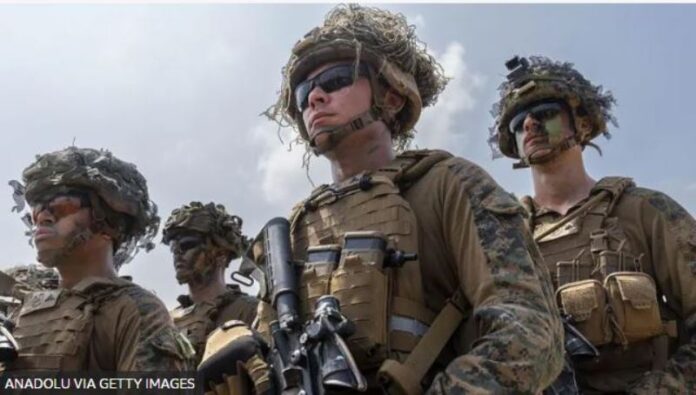
The United States is deploying rapid response forces to the Persian Gulf, with the 31st Marine Expeditionary Group already stationed there, while the 11th Marine Expeditionary Group and units from the 82nd Airborne Division are en route. The BBC’s Russian Service reports that according to CBS News, special forces—Navy SEALs and Army Rangers—are also being sent to the region. Unlike the forces already positioned, these units are intended for ground operations.
So far, the U.S. and Israel have refrained from large-scale ground actions on Iranian territory, but the concentration of airborne units signals a potential shift in tactics. These additional forces could involve up to 8,000 military personnel—around 2,500 Marines per expeditionary unit and between 3,000 and 4,000 paratroopers. These figures are approximate, excluding sailors on ships of the aircraft carrier and amphibious groups.
Experts suggest these forces could be deployed for one of three key scenarios: the blockade of the Strait of Hormuz, the capture of Hark Island, or a raid to extract enriched uranium from the country. The presence of rapid-response forces indicates the U.S. is expanding its military options, potentially escalating the conflict beyond its initial scope.
Breaking blockade of the Strait of Hormuz
Iran blocked the Strait of Hormuz shortly after the Allies' air campaign began in late February. Technically, it is easy to do: at its narrowest, the strait is only 50 kilometers wide, and it is vulnerable to missile attacks, mining, and drone boat assaults.
The scale of the problem is underscored by economic statistics: According to the U.S. Energy Information Administration for 2024, approximately 20% of the world’s liquefied natural gas trade passes through the strait, while in the first half of 2025, around 25% of the world’s oil shipments will flow through it. Shipping vessels, including supertankers, cannot navigate the strait not only due to physical threats but also because leading insurance companies have sharply increased premiums, making passage untenable for many shipowners.
U.S. President Donald Trump has demanded Iran reopen the strait by April 6, threatening to escalate airstrikes. However, if Tehran does not comply, the U.S. may deploy its troops for a forced reopening.
The seawall fortress
The blockade is supported by a series of islands, such as Abu Musa, Greater and Lesser Tomb, which are the subject of territorial disputes between Iran and the UAE. These islands host airstrips, air defense positions, and missile systems. The key target is Qeshm Island—the largest in the Gulf, which acts as a natural naval fortress. Nearby are the islands of Larak, Hormuz, and Hengam, home to underground missile bunkers and shelters for attack boats.
To force the opening of the strait, the U.S. would need to capture each of these islands. Given Iran’s defensive strategy, these islands are likely heavily fortified, making the operation highly risky.
The key oil terminal
Another scenario would involve seizing Hark Island, through which 90% of Iran’s oil trade passes. Cutting off Tehran’s access to the Hark terminal would target the financial foundation of Iran’s military programs, particularly its missile and nuclear projects. However, such an escalation would almost certainly provoke retaliatory strikes on critical infrastructure in the Gulf countries, which Iran has so far avoided.
In this context, a ground assault to capture the island is viewed as the most pragmatic approach. Unlike destructive airstrikes, establishing physical control would immediately block oil exports while keeping the infrastructure intact for future use by a new government.
The U.S. has already carried out a series of airstrikes targeting military installations on Hark Island. A priority for any amphibious operation would be the capture of the local airfield, which, after rapid repairs, could serve as an air bridge for deploying additional forces and equipment.
Islands and strategic positions
The capture of small islands near the coast is usually considered a prelude to a mainland invasion. Islands function as "unsinkable ships," providing air defense and support for landings. However, if no further advance is planned, troops on the islands become easy targets for coastal artillery.
In a situation where intercepting artillery shells is more difficult than missiles, holding the islands without control over the surrounding coast is extremely dangerous. Analysts note that for a full-scale invasion of the mainland, the current U.S. grouping is clearly understrength.
Uranium seizure
A further priority mission for the American forces could be the operation to seize Iran’s stockpiles of enriched uranium in Natanz and Isfahan. According to the Wall Street Journal, the Trump administration is considering a scenario in which U.S. special forces forcibly remove nuclear materials, which would require their presence on Iranian soil for several days.
Earlier, Washington had issued Tehran an ultimatum: lift sanctions in exchange for turning over all enriched uranium to the International Atomic Energy Agency (IAEA), including hundreds of kilograms enriched to 20% and 60%.
Executing such a raid would be technically complex. Experts say the operation’s success would depend on the complete suppression of Iranian air defense and the establishment of a temporary stronghold on the site.
The main threat during the transportation of uranium is not radiation, but the chemical properties of the material. Uranium is stored as uranium hexafluoride—a highly aggressive compound. Thus, the operation would require not only assault actions but also sophisticated engineering and chemical logistics under combat conditions.