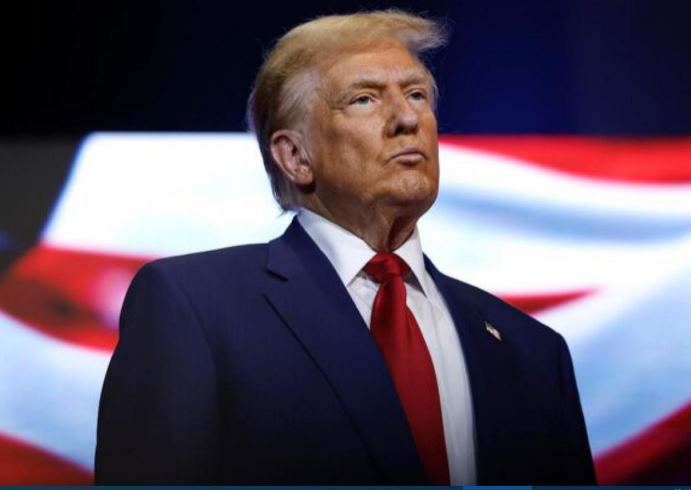
U.S. President Donald Trump has stated that the United States could halt military strikes on Iran within two to three weeks, asserting that a deal with Tehran is not a necessary condition for ending the ongoing conflict.
Just two days ago, Trump spoke about progress in negotiations and warned that failure to reach an agreement could lead to a "crushing blow" for Iran. However, his latest remarks highlight the contradictory stance of Washington on how the war, now in its fifth week, might come to an end, according to the BBC's Russian Service.
White House Press Secretary Caroline Levitt announced that President Trump would address the nation at 9:00 PM Washington time on Wednesday, providing an update on the situation with Iran.
According to Trump, the U.S. will "very soon" exit the conflict. "This could happen in two weeks, maybe in three," he told reporters. When asked whether successful diplomacy is required to conclude the U.S. operation "Epic Fury," he answered negatively. "Iran doesn't need to make a deal with me," he emphasized.
Trump further stated that the U.S. had already achieved its primary objective with the airstrikes initiated in late February: limiting Iran's capacity to develop nuclear weapons. He claimed that American forces were "finishing the job" and that Iranian authorities were "begging for a deal."
However, Iranian officials have denied these claims. They assert that no negotiations are taking place with the U.S., with contact limited to the exchange of messages through intermediaries, including Pakistan. Iran's Foreign Minister Abbas Araghchi confirmed receiving messages from U.S. Special Envoy Steve Whitcoff, but stated that this "does not mean negotiations."
Meanwhile, the U.S. is reinforcing its military presence in the Persian Gulf region. The 31st Marine Expeditionary Unit is already stationed there, and the 11th Carrier Strike Group, along with units from the 82nd Airborne Division, are heading to the area.
U.S. Secretary of Defense, Pete Hegseth, stated that Washington still hopes for a diplomatic resolution but is prepared to escalate military action if Tehran does not accept American terms. "Negotiations are real, active, and gaining momentum," he said.
At the same time, Iran's Islamic Revolutionary Guard Corps has issued threats against American companies operating in the Middle East, including Microsoft, Google, Apple, Intel, IBM, Tesla, Boeing, Hewlett Packard, Dell, and JPMorgan. The companies' representatives have been advised to leave their workplaces "for their own safety."
Iran insists that hostilities will only cease if security guarantees are provided and compensation for the damage caused is agreed upon. President Masoud Pezeshkian communicated this position in a conversation with European Council President António Costa.
Further tensions have arisen around the Strait of Hormuz, a vital waterway through which around 20% of global oil and liquefied gas supplies passed before the conflict. Shipping traffic in the area has dropped sharply, with only about ten vessels passing through per day, down from 140 previously.
In addition to the ongoing strikes, Israel has attacked targets in southern Beirut, and air defense systems have intercepted missiles near Damascus. Meanwhile, Iranian-backed Houthi rebels in Yemen launched a missile towards Israel.