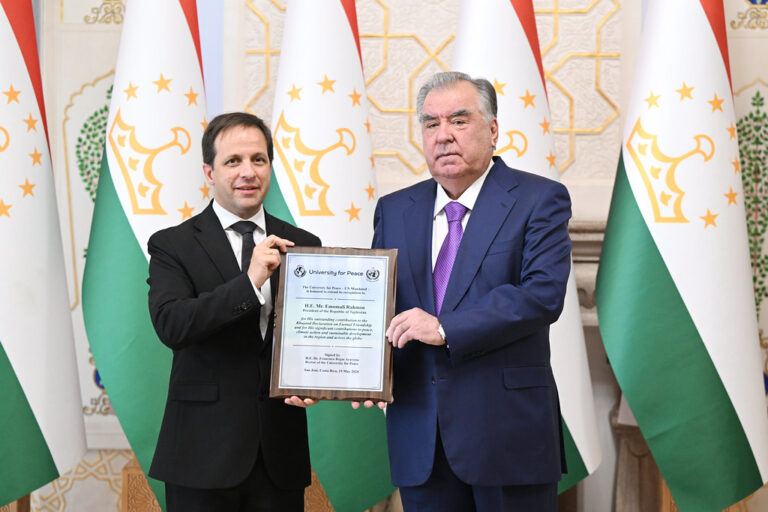
DUSHANBE, September 15, Asia-Plus — President Emomali Rahmon has signed a decree announcing the year of 2009 as Year of Imam Azam in Tajikistan, according to presidential press service.
Taking into account great services of al-Imam al-Azam Numan Thabit bin Zuta bin Mah, better known by his kunya as Abu Hanifa, (699 — 767 CE / 80 — 148 AH), for development of the Islamic culture and civilization as well as his great significance of his religious-jurisprudence heritage for formation of national self-consciousness, President Emomali Rahmon today signed the decree on announcement of 2009 as Year of Imam Azam in Tajikistan, press service said.
To implement the decree the government is to taken all necessary measures within two months.
Abu Hanifa was the founder of the Sunni Hanafi school of Islamic jurisprudence. He was also one of the Tabi’een, the generation after the Sahaba, because he saw the Sahabi Anas ibn Malik, and transmitted hadiths from him and other Sahaba.
Abu Hanifa was born in Kufa, Iraq during the reign of the powerful Umayyad capilph Abdul Malik bin Marwan. His father, Thabit bin Zuta, a trader from Kabul, part of Khorasan in Persia, (the capital of modern day Afghanistan),was 40 years old at the time of Abu Hanifa”s birth.
His ancestry is generally accepted as being of non-Arab origin as suggested by the etymology of then names of his grandfather (Zuta) and great-grandfather (Mah). The historian, Al-Khatib al-Baghdadi, records a statement from Abu Hanifa”s grandson, Ismail bin Hammad, who gave Abu Hanifa”s lineage as Thabit bin Numan bin Marzban and claiming to be of Persian origin. The discrepancy in the names, as given by Ismail of Abu Hanifa”s grandfather and great-grandfather are thought to be due to Zuta”s adoption of a Muslim name (Numan) upon his acceptance of Islam and that Mah and Marzban were titles or official designations in Persia. Further differences of opinion exist on his ancestry. Abu Muti, for example, describes Abu Hanifa as an Arab citing his ancestry as Numan bin Thabit bin Zuta bin Yahya bin Zaid bin Asad. The widely accepted opinion, however, is that he was of Persian ancestry.