

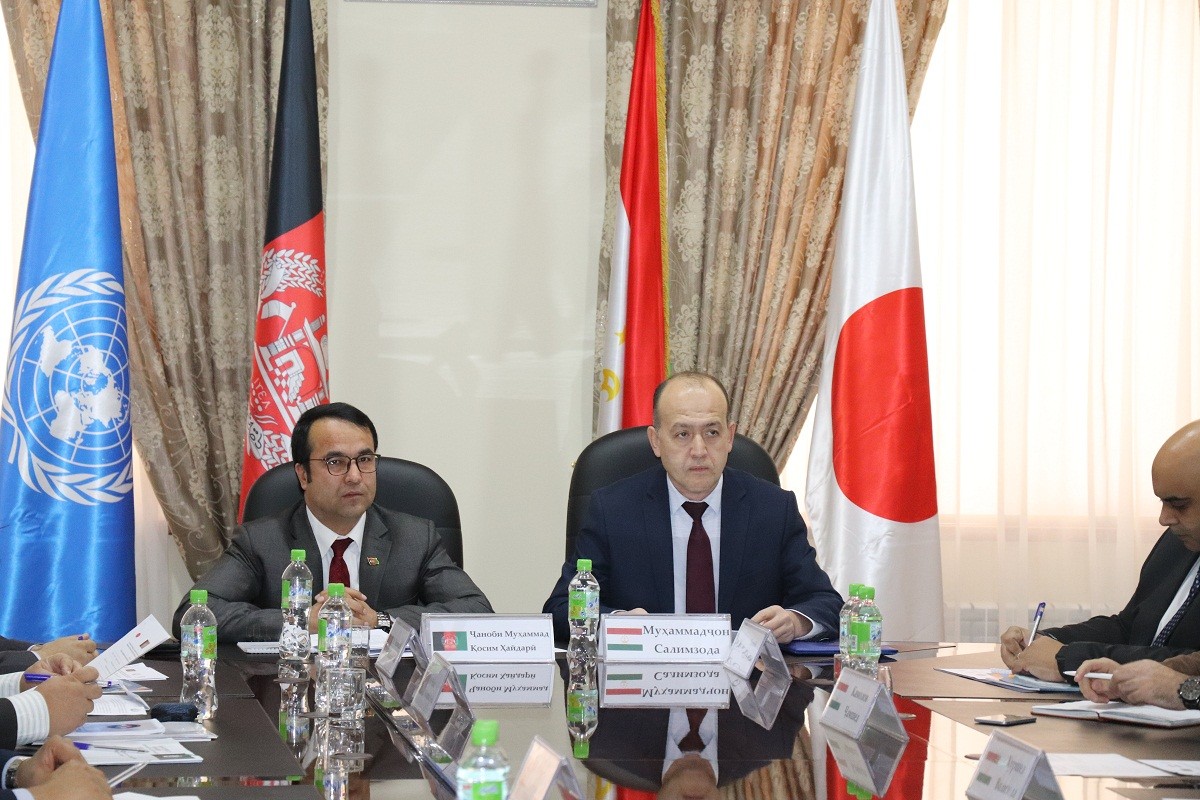
On Tuesday December 25, UNDP held the second annual technical meeting to bring officials from the Committee on Emergency Situations and Civil Defense under the Government of Tajikistan and the Afghanistan National Disaster Management Authority together in an effort to advance cross-border cooperation in disaster preparedness and risk mitigation.
According to UNDP Office in Tajikistan, the meeting is the next step after initiation of the partnership early this year through establishing a dialogue platform between the two government’s responsible bodies.
“Afghanistan National Disaster Management Authority has a limited access to some districts in Afghanistan during emergency situations while Tajik counterparts can dexterously reach them. Thus, cross-border cooperation between Tajikistan and Afghanistan is crucially important in emergency preparedness and response,” Mohammad Qaseem Haidari, Deputy Minister for Policy, Coordination, and Planning of ANDMA said.
Highlighting the importance of the agreement, Deputy Chairman of CoES in Tajikistan Muhammadjon Salimzoda said that it “will lay a foundation for continuous and effective cooperation, where CoES will assist in capacity building of Afghan search and rescue teams”.
The goal of this technical meeting, held within the UNDP “Strengthening Disaster Risk Reduction and Response Capacities” project funded by the Government of Japan, was to compose a working group that will lead the development of a Joint Action and Midterm Plan of Cooperation and Interoperability for 2019-2020 in emergency preparedness and response.
The group is also expected to review and discuss the Bilateral Agreement, a document that outlines forms, conditions and terms of cooperation between the neighboring countries during emergency situations.
In 2016, UNDP signed new project document with CoES and corresponding funding schemes agreed with the Government of Japan for the implementation of project to strengthen disaster risk reduction, preparedness and response capacities. The forth component of the projects intends to improve cross-border disaster preparedness and response in line with the Sendai priority of enhancing preparedness for effective response and in terms of preventing human and material losses from disasters.
