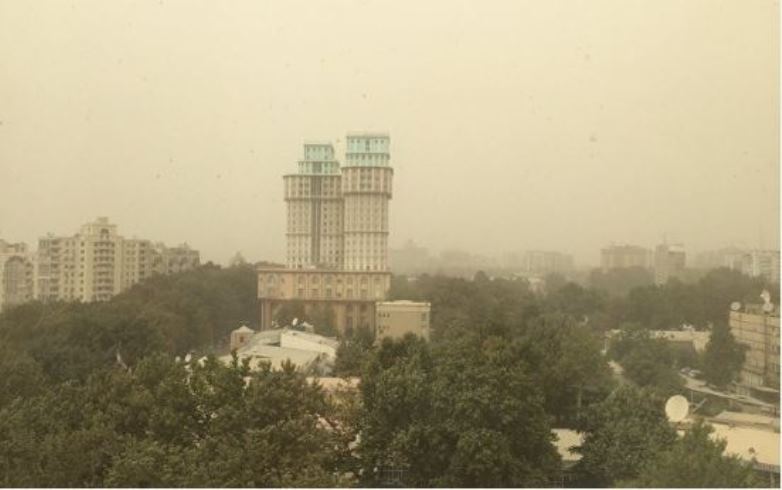
The United Nations estimates that 80 percent of the Tajik population is exposed to the highest concentrations of fine particles, known as PM2.5.
Experts note that these types of storms used to be rare but they now start in spring and continue into the autumn in large parts of Central Asia.
Ms. Zebuniso Muminzoda, head of the Tajik branch of the Regional Environmental Center for Central Asia, notes that in the 1990s, there were two or three sand and dust storms per year in Tajikistan, while “now there can be up to 35.”
"Because of climate change, longer dry seasons lead to sand and dust storms by drying out the ground and stronger winds then pick up this dry soil," she said.
The storms often start out in the dried-out stretches of the Aral Sea in Uzbekistan but also in the Kazakh steppes and in neighboring Afghanistan.
Muminzoda pointed to a "human factor", saying forestry, bad irrigation and year-round livestock farming were all contributing to "degrading the soil".
It is a vicious circle for a poor, mainly rural country like Tajikistan, where the toxic storms also have a negative effect on farming and soil fertility.
The sand and dust also falls on the region's many glaciers—a crucial source of water in the region and “speeds up their melting,” the expert said.
The Central Asian nations are reportedly attempting common efforts to tackle environmental questions like water management and nuclear waste disposal.
Meanwhile, the UN Convention to Combat Desertification (UNCCD) notes that sand and dust storms are an underappreciated problem now “dramatically” more frequent in some places worldwide, with at least 25% of the phenomenon attributed to human activities.
Accompanied by policy recommendations, the warning came at a five-day 21st session of the UNCCD Committee for the Review of the Implementation of the Convention (CRIC 21) that took place in the Uzbek city of Samarkand.
“Sand and dust storms (SDS) have become increasingly frequent and severe having substantial transboundary impacts, affecting various aspects of the environment, climate, health, agriculture, livelihoods and the socioeconomic well-being of individuals. The accumulation of impacts from sand and dust storms can be significant,” Feras Ziadat, Technical Officer at the Food and Agriculture Organization of the UN (FAO), Chair of the UN Coalition on Combating Sand and Dust Storms, said.
According to UNCCD, the SDS discussion formed part of the agenda of the 21st session of the UNCCD Committee for the Review of the Implementation of the Convention in Samarkand.