Paleontologists discover an ancient camel skull in Tajikistan

The earliest-known camels dwelled in the territory of modern Tajikistan about 2.5 million years ago.  A camel scull discovered by a joint group of Russia and Tajik paleontologists in Tajikistan is 2.5 million years old discovered a camel skull that is 2.5 million years.    The Russian and Tajik paleontologists have reportedly discovered a unique […]

Asia-Plus

The earliest-known camels dwelled in the territory of modern Tajikistan about 2.5 million years ago. 

A camel scull discovered by a joint group of Russia and Tajik paleontologists in Tajikistan is 2.5 million years old discovered a camel skull that is 2.5 million years.   

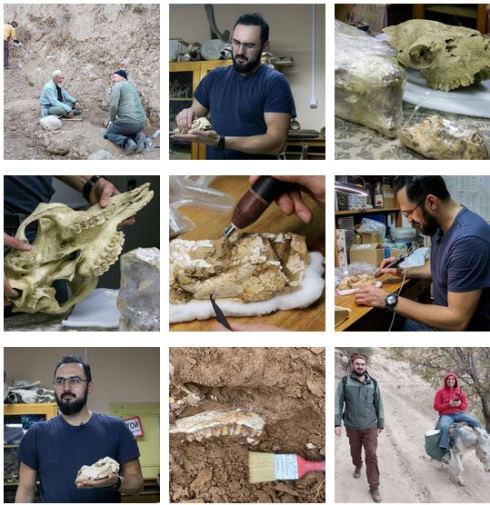
The Russian and Tajik paleontologists have reportedly discovered a unique find in the Kuruksai hole (Baljuvon district in Tajikistan’s Khatlon province).

The Ural Federal University (UrFU)’s website noted on November 29 that the find is of great value since researchers usually find individual parts of the skull or bones, and this skull was found intact.

The find was delivered to Yekaterinburg, the capital of Russia’s Sverdlovsk oblast, for restoration and study for three years.  Then the skull will be returned to Tajikistan for further research.

It is noted that that with such ancient remains, scientists will be able to determine what the camel ate and what its brain size was.

“If we compare the found skull with the skull of a modern camel, the sizes are approximately the same,” said Dmitry Girmanov, a senior fellow, UrFU Laboratories of Natural Science Methods in Humanities Research.   

The Ural Federal University notes that during the early Pleistocene, the savanna-like landscapes with climates similar to climate of modern North Africa spread across the territory of Tajikistan.  Scientists suggest that ancient camels adapted to these conditions did not have characteristic humps.   In a favorable environment they did not require a long-term supply of nutritional resources. 
Join us on social media!

Article translations:

Related Article

Оби зулол
Оби зулол

Most Read

Recent Articles

The only GPW veteran in Dushanbe allocated more than 80,000 somoni

The mayor's office of Dushanbe allocated him 25,000 somoni.

GITEX AI Kazakhstan 2026: how Almaty became the main AI hub of Central Asia

More than 300 companies and startups, over 200 speakers and 100 investors from 50 countries — the region is entering the global stage.

A trade and economic park to be built at the border junction of Tajikistan, Kyrgyzstan, and Uzbekistan

President of the Kyrgyz Republic Sadyr Japarov familiarized himself with the project.

A project to protect soil from degradation to be developed in Central Asia

The initiative is of great significance for the mountainous countries of the region, including Tajikistan.

Mudslide, death, and destroyed homes: hundreds of families in Tajikistan left homeless

A correspondent from "Asia-Plus" visited Kulob and spoke with the families of those who died and were affected by the disaster.

Spring 2026 bright event: new issue of VIPzone now on sale

This issue is about people and ideas that change everything: from business and investments to fashion, food, and urban environment.

Godfrey Sullivan: “Tajikistan is a promising market for Visa to develop digital payments”

The Vice President of Visa explained why Tajikistan is becoming a promising market for digital payments and how artificial intelligence is influencing the future of finance.

Seven students in Dushanbe were threatened with expulsion for arriving at universities in personal cars

The materials for each case have been sent to the Ministry of Education and Science for appropriate actions.

India’s blockchain push and lessons for the global south

The Indian Government has started pushing aggressively its agenda...

India’s blockchain push and lessons for the global south

The Indian Government has started pushing aggressively its agenda...