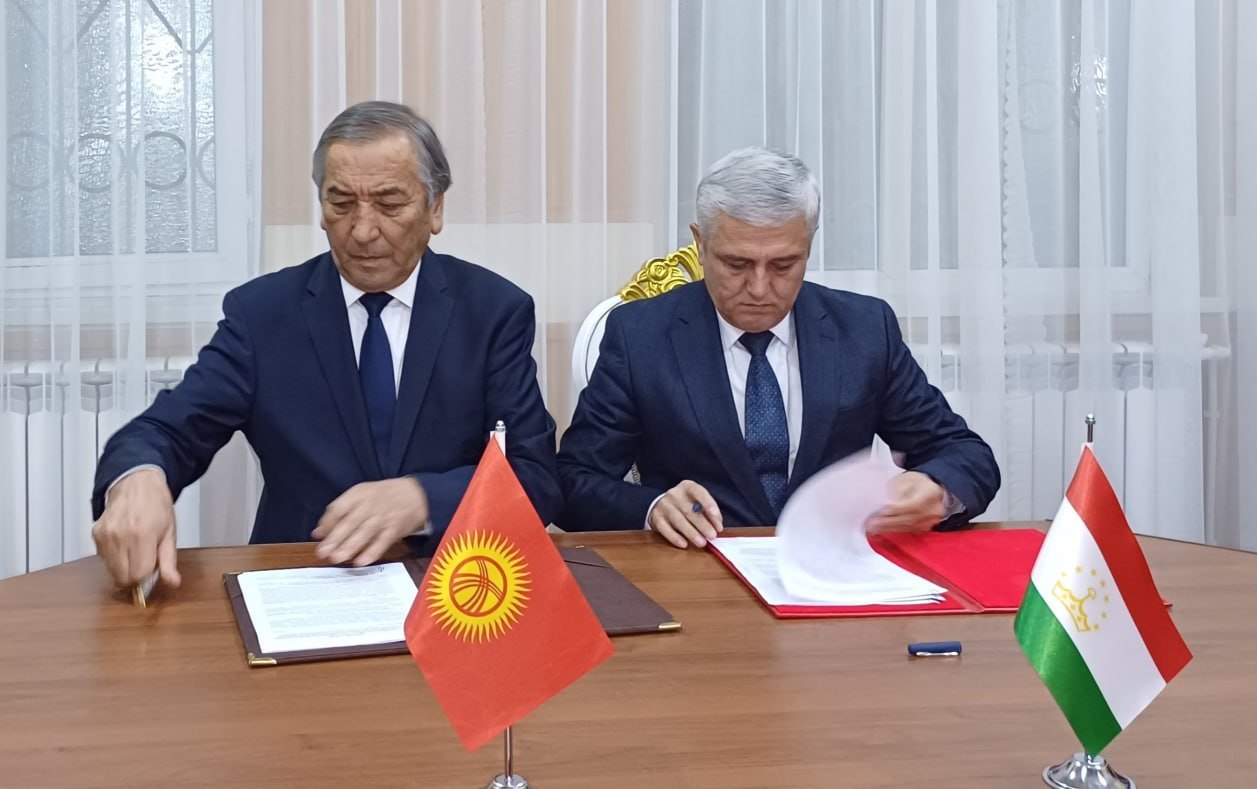
Tajikistan and Kyrgyzstan have reportedly defined another little more than 24.01 kilometers of the mutual border.
The topographical working groups on delimitation and demarcation of the mutual border of the government delegations of Tajikistan and Kyrgyzstan met in the Tajik northern city of Buston, Sughd province from November 29 to December 5.
The press service of Kyrgyzstan’s Cabinet of Ministers says the meeting ended with signing of a protocol. The document was signed by Orif Khojazoda, the head of the State Committee for Land Management and Geodesy of Tajikistan, and Nazirbek Borubayev, the Special Representative of the Cabinet of Ministers for border issues.
Kyrgyzstan’s Cabinet of Ministers notes that the parties will continue the work on defining the remaining disputed stretches of the border at the next meeting that will take place in Kyrgyzstan.
Over the past three months, the working groups have defined almost 100 kilometers of the shared border.
Recall, Saimumin Yatimov, the head of Tajikistan’s State Committee for National Security (SCNS), and his Kyrgyz counterpart, Kamchybek Tashiyev, met in the Tajik city of Buston on December 1 for talks that reportedly produced “key decisions” on how to resolve differences over the border.
According to Eurasianet, in remarks to journalists following negotiations, Tashiyev spoke in vague generalities, although he ventured that “we are very close to settling all matters.”
Yatimov was more discursive.
He said that a breakthrough solution had been agreed on how to manage use of the Vorukh-Khojai A'lo road, which crosses Kyrgyz territory and links the mainland of Tajikistan to the densely populated Tajik enclave of Vorukh.
The point where the Kyrgyz and Tajik roads intersect has long served as a flashpoint for confrontations between local residents. When clashes broke out in the past, Kyrgyz communities have been able to dangle the threat of placing Vorukh under a blockade as leverage.
Yatimov reportedly gave no details on what had been agreed.
The Tajik security services chief continued, again without dwelling on specifics, to say Kyrgyzstan and Tajikistan have agreed that both countries will enjoy “permanent and uninterrupted” access to lands belonging to them but lying within the confines of the other country.
While for Tajikistan this is a clear allusion to Vorukh, it is less obvious which Kyrgyz territory falls under this description. Possible candidates are Kyrgyz towns such as Arka and Borborduk, which can be reached on winding and uneven Kyrgyz roads that Tajik border troops have periodically threaten to block, Eurasianet noted.
The two Central Asian nations have been meeting for months in an effort to resolve border disputes that have led to deadly clashes between them in recent years.
Tajikistan and Kyrgyzstan have not yet resolved the border delineation problem. Many border areas in Central Asia have been disputed since the collapse of the Soviet Union in 1991. The situation is particularly complicated near the numerous exclaves in the Fergana Valley, where the borders of Tajikistan, Uzbekistan, and Kyrgyzstan meet.
The border of Kyrgyzstan and Tajikistan has been the scene of unrest repeatedly since the collapse of the former Soviet Union. Border talks between Tajikistan and Kyrgyzstan began in 2002. The countries share 972 kilometers of border – of which more than 660 kilometers have been properly delineated, leading to tensions for the past 30 years.
To-date, Tajikistan and Kyrgyzstan have reportedly held more than 170 meetings and negotiations on delimitation and demarcation of the common border.