Kazakhstan hosts command-staff drill for CSTO Collective Peacekeeping Force

TASS, citing Kazakhstan’s Ministry of Defense, reports that command-staff drill for the Collective Security Treaty Organization (CSTO) Collective Peacekeeping Force, dubbed “Indestructible Brotherhood-2024”, is being conducted in Kazakhstan from September 26 to October 7.       According to a statement from the CSTO press center, military contingents from Russia, Belarus, Kyrgyzstan, and Tajikistan joined their Kazakh […]

Asia-Plus

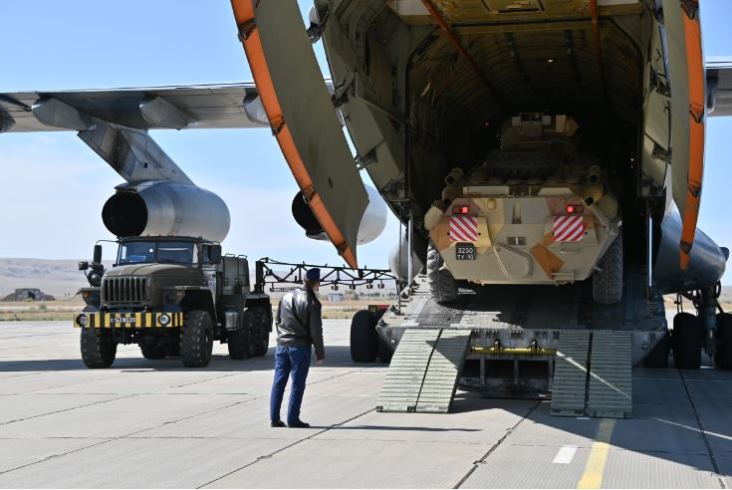
TASS, citing Kazakhstan’s Ministry of Defense, reports that command-staff drill for the Collective Security Treaty Organization (CSTO) Collective Peacekeeping Force, dubbed “Indestructible Brotherhood-2024”, is being conducted in Kazakhstan from September 26 to October 7.      

According to a statement from the CSTO press center, military contingents from Russia, Belarus, Kyrgyzstan, and Tajikistan joined their Kazakh counterparts for the joint maneuvers, which are being conducted at the Bereg training ground in Kazakhstan’s Almaty region.  

The priorities identified by Kazakhstan, which is chairing the Organization this year, are to improve the issues of ensuring the operational deployment of Troops (Collective Forces), including the unimpeded transit of contingents, as well as the development of the CSTO peacekeeping potential.

Commander of Kazakhstan’s Airborne Assault Troops, Major-General Almaz Dzhumakeyev, is in overall command of the ongoing exercise focusing on the preparation and conduct of a peacekeeping operation by the CSTO Collective Peacekeeping Force.  

On October 6, 2007, CSTO member nations agreed to a major expansion of the organization to create a CSTO Peacekeeping Force that could be deployed under a U.N. mandate or without one in its member nations.

On December 10, 2010, the member nations approved a declaration establishing the CSTO Peacekeeping Force and a declaration of the CSTO member nations, in addition to signing a package of joint documents.

The CSTO peacekeeping forces are made up of specially trained military, police, and civilian personnel from member states, with the composition and size of each peacekeeping mission determined by the CSTO Collective Security Council based on the specific situation and mission requirements.  The formation is reinforced with tanks, artillery, air-defense equipment and other special capabilities.

The Collective Security Treaty Organization currently includes Russia, Armenia, Belarus, Kazakhstan, Kyrgyzstan and Tajikistan.

Meanwhile, Armenia's Prime Minister Nikol Pashinyan announced on June 12 this year that his country would pull out of the Collective Security Treaty Organization (CSTO), amid a widening rift with Moscow.  He did not provide details on when and how.
Join us on social media!

Article translations:

Related Article

Оби зулол
Оби зулол

Most Read

Recent Articles

The only GPW veteran in Dushanbe allocated more than 80,000 somoni

The mayor's office of Dushanbe allocated him 25,000 somoni.

GITEX AI Kazakhstan 2026: how Almaty became the main AI hub of Central Asia

More than 300 companies and startups, over 200 speakers and 100 investors from 50 countries — the region is entering the global stage.

A trade and economic park to be built at the border junction of Tajikistan, Kyrgyzstan, and Uzbekistan

President of the Kyrgyz Republic Sadyr Japarov familiarized himself with the project.

A project to protect soil from degradation to be developed in Central Asia

The initiative is of great significance for the mountainous countries of the region, including Tajikistan.

Mudslide, death, and destroyed homes: hundreds of families in Tajikistan left homeless

A correspondent from "Asia-Plus" visited Kulob and spoke with the families of those who died and were affected by the disaster.

Spring 2026 bright event: new issue of VIPzone now on sale

This issue is about people and ideas that change everything: from business and investments to fashion, food, and urban environment.

Godfrey Sullivan: “Tajikistan is a promising market for Visa to develop digital payments”

The Vice President of Visa explained why Tajikistan is becoming a promising market for digital payments and how artificial intelligence is influencing the future of finance.

Seven students in Dushanbe were threatened with expulsion for arriving at universities in personal cars

The materials for each case have been sent to the Ministry of Education and Science for appropriate actions.

India’s blockchain push and lessons for the global south

The Indian Government has started pushing aggressively its agenda...

India’s blockchain push and lessons for the global south

The Indian Government has started pushing aggressively its agenda...