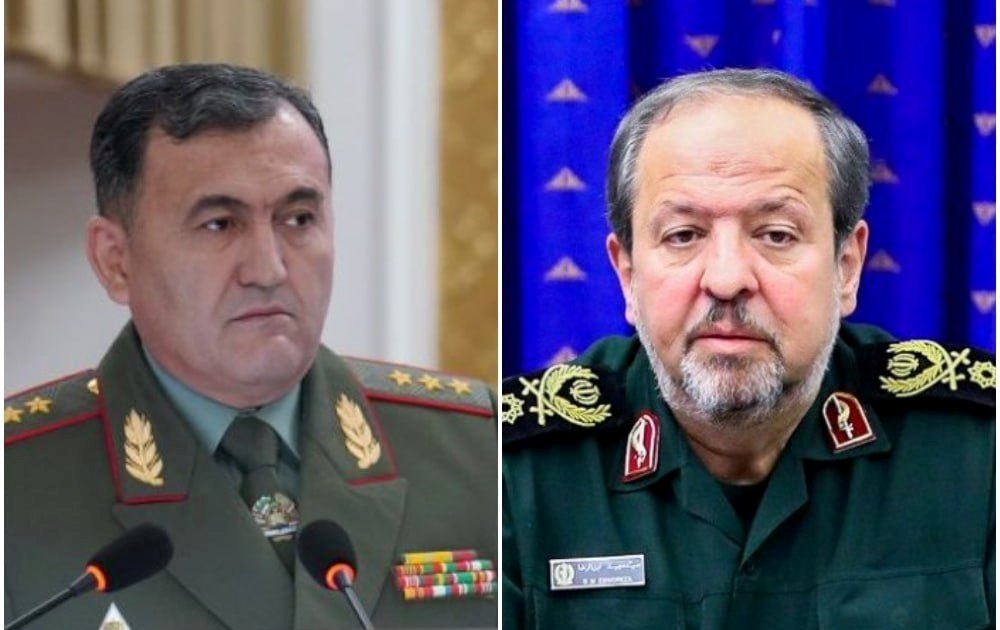
The Minister of Defense of Tajikistan Emomali Sobirzoda held a phone conversation yesterday with Majid Ibni Reza, the acting Minister of Defense of Iran, reports the Iranian state broadcasting company.
According to the source, during the conversation, Sobirzoda emphasized the importance of “establishing true peace and stability” for Iran and “the people who share a common language, culture, and civilization.”
Majid Ibni Reza expressed gratitude for the political stance and humanitarian aid of Tajikistan, “provided in support of the state and people of Iran.”
Previously, the government of Tajikistan, on the instructions of President Emomali Rahmon, sent humanitarian aid to the people of Iran.
A humanitarian convoy of 110 heavy trucks left Dushanbe for Iran on March 18. The total volume of the cargo amounted to 3,610 tons, including 45 tons of medicines, sanitary and hygiene products, children’s clothing, foodstuffs, essential items, bedding, tents, construction materials, and other necessary goods.
Previously, the US announced its readiness for a two-week ceasefire with Iran. US President Donald Trump stated on the social network Truth Social that Washington agreed to a bilateral ceasefire with Iran for a period of two weeks. According to him, the decision was made after negotiations with the Prime Minister of Pakistan Shahbaz Sharif and the Commander-in-Chief of the country’s ground forces Asim Munir.
Trump noted that the US is ready to suspend strikes on the condition of the full, immediate, and safe opening of the Strait of Hormuz.
Soon, the agreement on the ceasefire was also confirmed by Iran’s Supreme National Security Council. The country’s Foreign Minister Abbas Araghchi published the corresponding statement on his page on X.
According to the Iranian side’s statement, the 10-point plan proposed by Tehran became the basis for the negotiations. It includes, in particular, commitments of non-aggression, the lifting of sanctions, the withdrawal of American troops from the region, and the maintenance of Iran’s control over the Strait of Hormuz.
Tehran also declared its readiness to ensure safe navigation in the Strait of Hormuz for two weeks under its conditions, while emphasizing its readiness to respond to any violations.
The US and Israel began striking Iran on February 28. On the very first day of hostilities, according to sources, Iran’s Supreme Leader Ali Khamenei and dozens of high-ranking military leaders of the country were killed.
In response, Tehran began attacks on Israel and countries it considers US allies — the UAE, Bahrain, Kuwait, Qatar, and other countries in the region.