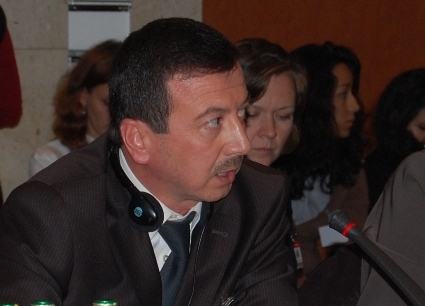
WARSAW, September 29, 2011, Asia-Plus — Ina statement delivered at the annual OSCE Human Dimension Implementation Meeting in Warsaw, Mr. Bahriddin Bozorov, the deputy chief of the Directorate for the Investigation of Especially Important Cases at the Tajik Prosecutor-General’s Office, stated on September 28 that there is no constant practice of gross violation of human rights in Tajikistan.
According to him, Tajikistan rigorously fulfills its obligations on international torture prevention documents and introduces efficient legal, administrative and judicial measures to ensure prevention of such practices.
Tajik prosecutor expressed concern that various international organizations have noted use of torture in Tajikistan in their reports in recent years, and therefore, they consider it inadmissible to extradite wanted criminals to Tajikistan.
“An enough legal foundation for prevention of torture and other cruel or degrading treatment has been laid in Tajikistan,” said Bozorov, “We consider all acts of torture, various forms of its manifestation, torture attempt or complicity in torture as crimes, and although, there is no a special article in Tajikistan’s Criminal Code devoted to torture, various forms of manifestation of torture, depending on concrete circumstances, are criminalized in a number of its articles.”
In 2010 and the first eight months of this year, 13 officers from the Ministry of Interior and three officers from the Main Directorate for Execution of Criminal Punishments at the Ministry of Justice have been convicted for abuse of office, Bozorov noted.
In the meantime, Qayum Yusufov, member of the Board of the Tajikistan Collegium of Advocates “Sipar,” noted that although Tajikistan had ratified all international legal documents on human rights, including the United Nations Convention against Torture and Other Cruel, Inhuman or
Degrading Treatment or Punishment, tortures was used in the country against persons suspected of committing crimes related to terrorism and extremism.
“The problem is that it is very difficult to prove the use of torture to supervisory bodies such as prosecutor’s offices and courts,” Yusufov said, adding that a court that must be an independent organ and impartially consider the case demands incontrovertible evidence of the use of torture from suspects and defendants person. “It is impossible for person in custody to produce such evidence,” he noted.