
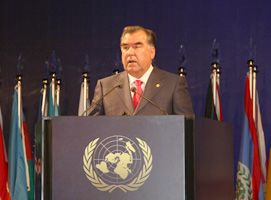
DUSHANBE, June 21, 2012, Asia-Plus /Avaz Yuldoshev/ — On June 20, President Emomali Rahmon delivered a statement at the general session of the UN Conference on Sustainable Development in Rio de Janeiro, Brazil.
The president’s official website reports the UN Secretary-General Ban Ki-moon opened the Conference. The Conference unanimously chose the President of Brazil Dilma Rousseff as the president of the Conference and President Emomali Rahmon as one of her deputies.
In a statement delivered at the session, Tajik leader expressed confidence that the Conference would give a new impulse to further development of world economy.
In his statement, Emomali Rahmon paid particular attention to the National Development Strategy based on the MDGs, the crux of which consists of three main issues – achieving energy independence, overcoming transport and communication deadlock and ensuring food security of the country. As the Tajik President accentuated, according to this Strategy the effective and economical use of natural resources, which embody the main element of “green economy”, as well as the enhancement of social sector and protection of ecological system are the component of reforms realized in Tajikistan. “Comprehensive access to modern energy service, increasing energy efficiency, expanding use of renewable energy sources are the most important issues of sustainable development”, Emomali Rahmon stated.
Tajik leader also expressed support of Tajikistan for the initiative of the UN Secretary-General “Sustainable Energy for All”. According to him, “use of hydropower fully corresponds with the conception of “green economy”, which is among the main subjects of Rio+20 Conference agenda.
Tajik head of state drew the attention of the floor to three intimately related environmental, economic and social issues – climate change, natural disasters and sustainable development of mountain areas. He voiced hope that international institutions and donor countries will support the proposal of Tajikistan on the establishment of the International Fund for Protection of Glaciers.
Rahmon also noted that the findings of a joint survey, which was conducted by the government in cooperation with independent organizations, have shown that the poverty rate in Tajikistan decreased from 73 percent in 2003 to 53 percent in 2007 and 41 percent in 2012. “If this trend continues, the poverty rate will reduce to 30 percent by 2015,” Rahmon noted.
