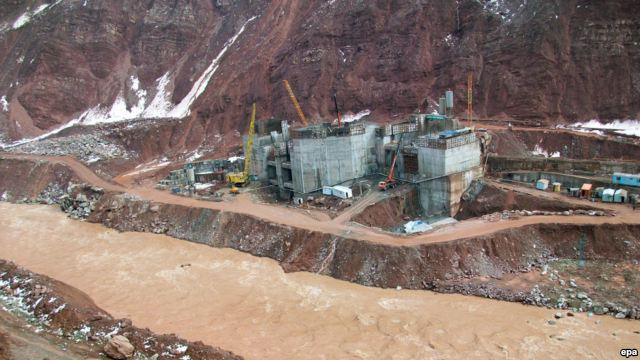
DUSHANBE, November 7, 2012, Asia-Plus — Tajik ecologists are offering to consider in the framework of the Environmental and Social Impact Assessment (ESIA) also the positive effects that the Roghun Hydropower Project (HPP) may have on the region.
Umed Ulughov, ecology program coordinator, NGO “Youth of the 21st Century” says the Tajik delegation has offered this suggestion during the discussion of the ESIA Screening Report in Astana, Kazakhstan.
According to him, representatives of Tajikistan have noted that the Report does not reflect positive impacts that the Roghun HPP may have on the regional microclimate.
“The Roghun hydroelectric power plant will generate ecologically pure electricity access to which will be available for all countries,” said Ulughov. “This will allow preserving forests and hydrocarbons. Besides, decrease in use of hydrocarbons will lead to reduction in greenhouse gas emissions that cause ice glaciers to melt. We are sure that introduction of the Roghun power plant into operation will allow reducing use of hydrocarbons by the countries of the region and this will allow slowing down the glacier melting process.”
He noted that all those moments must be reflected in the Environmental and Social Impact Assessment.
The second information-sharing and consultation meeting with civil society on the Assessment Studies of the proposed Roghun Hydropower Project (HPP) in Tajikistan is being held today at the World Bank’s Central Asia Regional Office in Almaty and by video- or telephone connections from World Bank Country Offices in Ashgabat, Astana, Bishkek, Dushanbe, Kabul, and Tashkent.
According to the World Bank, the second information-sharing and consultation meeting focuses on the Environmental and Social Impact Assessment (ESIA) Screening Report, which identifies the assessment’s methodology and selected critical environmental and social impact factors, as well as the interim findings of the Techno-Economic Assessment Study (TEAS).
The first information-sharing and discussion meeting on the assessment studies for the Roghun Regional Water Reservoir and Hydropower Project (Roghun HPP) took place in Almaty last year, from May 17 to May 19. The government delegations met on May 17-18 and a discussion meeting for representatives of civil society took place on May 19. Uzbekistan ignored last year’s delegation information-sharing and discussion meeting.
We will recall that in response to a request by the Government of Tajikistan, the World Bank is supporting these two studies to evaluate the viability of the proposed Roghun Hydropower Project (HPP) according to international standards. These Assessment Studies have been conducted by international consultant firms contracted on a competitive basis by the Government of Tajikistan and financed through an IDA project with assistance of World Bank experts. The studies were contracted to two international firms and the procurement process was monitored closely by the World Bank. A consortium led by Coyne & Bellier is conducting the TEAS (contact signed on February 8, 2011) while Poyry of Switzerland is conducting the ESIA (contract signed on March 25, 2011).
The Assessment Studies aim to examine the potential benefits and risks of the proposed Roghun HPP and comprehensively evaluate its technical, economic, social, and environmental viability based on international standards and practices and in accordance with the World Bank’s policies and procedures. The Studies will provide the Government of Tajikistan, the World Bank, the other Central Asian countries and the international community with information about key elements associated with the proposed Roghun HPP, such as the project’s technical soundness and safety, economic viability and compliance with all relevant environmental and social safeguards.
Tajikistan’s plans to build the Roghun HPP have raised serious concerns across the border in Uzbekistan. Uzbek officials argue that because it could take up to 18 years to fill, the Roghun project will severely reduce the amount of water flowing into Uzbekistan.
In March 2010, the government of Tajikistan and the World Bank signed a memorandum of understanding (MoU) on cooperation to achieve sustainable development of Tajikistan”s energy resources, secure supply of energy services to the people of Tajikistan and promote balanced economic growth. Under this document, the techno-economic, the environmental and social impact assessments for the Roghun hydroelectricity project will be conducted Hydropower Project (HPP).
The World Bank and the Government of Tajikistan have reached an understanding that no new construction would commence until after the techno-economic and environmental/social studies have been shared and discussed with riparians, and the studies are reviewed by the independent Bank-funded Panel of Experts to determine feasibility.