Issues of participation of women in voting process discussed in Dushanbe

DUSHANBE, November 2, Asia-Plus – A roundtable meeting formally entitled “Participation of Women in the Voting Process” was held in Dushanbe today.   Participants at the meeting, staged by Tajikistan’s Central Commission for Elections and Referenda (CCER) in cooperation with IFES Tajikistan, included representatives from political parties, women’s NGOs and media.  Ms. Kathryn Muller, the […]

Nargis Hamroboyeva

DUSHANBE, November 2, Asia-Plus – A roundtable meeting formally entitled “Participation of Women in the Voting Process” was held in Dushanbe today.  

Participants at the meeting, staged by Tajikistan’s Central Commission for Elections and Referenda (CCER) in cooperation with IFES Tajikistan, included representatives from political parties, women’s NGOs and media. 

Ms. Kathryn Muller, the head of the IFES CO in Tajikistan, noted that the main objective of the meeting was to define measures to stimulate active participation of Tajik women in political life of the country, including participation in parliamentary and presidential elections in Tajikistan.  Such events help active women from political parties, NGOs, media, universities get ready for the next parliamentary (2010) and presidential elections (2013) in the country, and probably standing for president.      

Muhibullo Dodojonov, a spokesman for the CCER, telling the meeting noted that 17 of 68 constituencies for a November 6 presidential election are headed by women.  Dodojonov stressed that the electoral commissions should carry out work in a fashion that all voters in the constituencies participate in the upcoming presidential election.   

Jan Smith, an adviser to the IFES Tajikistan director, noted that in Muslim-dominated states a quota for women in parliament is very low.  For example, in Afghanistan, this quota makes only 5 percent, and globally, women constitute only 8 percent of those contending for presidency.   The best situation in this term is reported in Scandinavian countries, Germany and the Netherlands where women constitute from 35% to 45% of MPs.  While in Tajikistan, this figure is nearly 13 percent.  

Smith also stressed that globally, only some 30 percent of women are leading an active political life.  In Tajikistan, compared to the previous years representation of women in organs of power of all levels has increased; however, it is still extremely low.  

Some experts hold that cultural factors such as a tradition of domination of men in state structures, patriarchal values of electorate, insufficient organizing factors of political struggle are the main reasons impeding women’s entry into politics.   

Participants at the meeting also expressed regret that no political party in Tajikistan had nominated woman as candidate for president.
Join us on social media!

Article translations:

Related Article

Tenisi
Оби зулол
Оби зулол

Most Read

Коммерсбонк Точикистон

Recent Articles

Major global investment companies show interest in Tajikistan’s economy

Among them are J.P. Morgan, Loomis Sayles & Company, Morgan Stanley Investment Management, and Global Evolution.

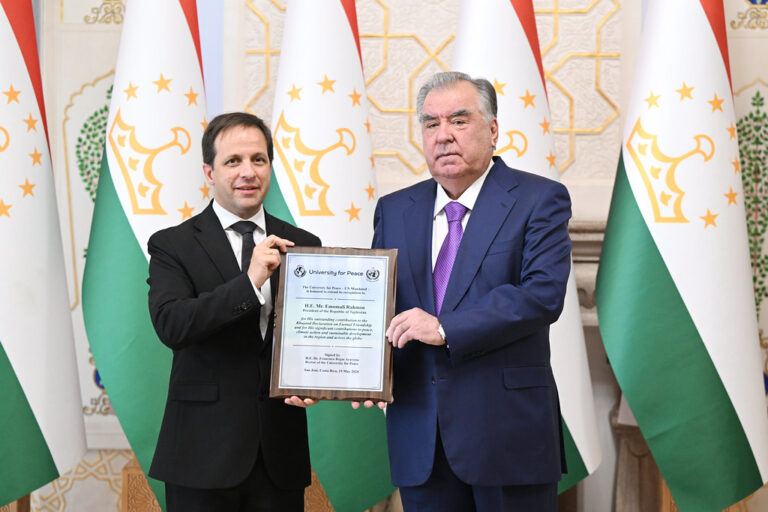
President Rahmon awarded UN University for Peace Certificate of Recognition

He is awarded for "significant contribution to establishing peace, developing regional cooperation, and strengthening mutual understanding between peoples."

Starlink satellite internet becomes available in Kyrgyzstan

And in Tajikistan, it was launched in February of this year.

In Dushanbe, 30 more new electric buses start operating

Each is designed to carry 100 passengers and can travel up to 300 kilometers without recharging.

Who is the man who “increased the Aryan race” and told the President of Tajikistan about it?

Kozie Koziyev, a folk craftsman, built dozens of houses, participated in the construction of a mosque and a kindergarten in Matcha, raised 11 children, and created a true dynasty of builders.

Tajik leader discusses water, climate, and global security issues with UN Deputy Secretaries-General

The parties paid special attention to the "Dushanbe Water Process," parliamentary diplomacy, and the peaceful resolution of conflicts.

Tajikistan completes the spring military draft target ahead of schedule

There is still a week left until the end of the conscription campaign.

Custodian of non-written languages and builder of academic bridges; philologist Khusrav Shambezoda turns 70

He could have devoted himself exclusively to the study of classical heritage, but he chose the challenging path of preserving the living word — and Tajik-Russian science gained in him a brilliant sociolinguist whose name became synonymous with dedication.

Tajikistan ranks among the top three leading trade reformers in Europe and Central Asia

The country has shown progress in the digitalization of trade procedures, the reduction of paper barriers, and the enhancement of transparency for exporters.

China to send workers to Tajikistan for modernization of the Kulma BCP

This is the only land border crossing point between Tajikistan and China.