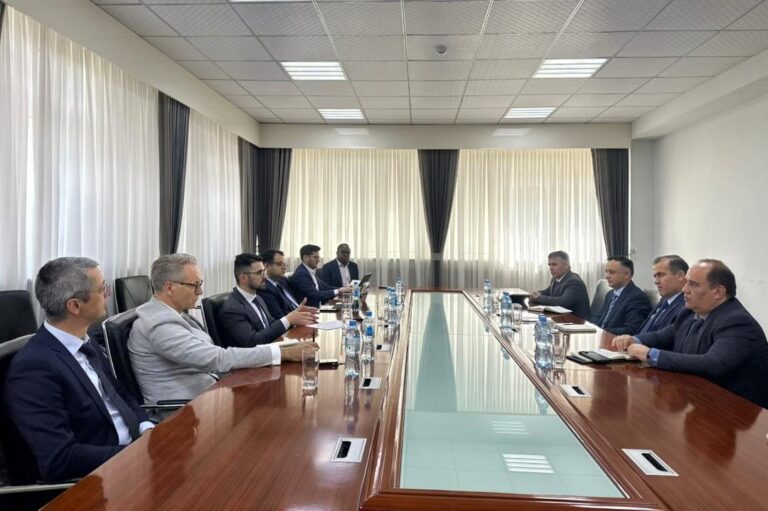
DUSHANBE, December 13, Asia-Plus — Presentation of the first stage of the Dushanbe Solid Waste Management Project was held in the Tajik capital city on Wednesday, December 13. The project implemented by the Dushanbe mayor’s office with support of Sweden’s SWECO is funded by the European Bank for Reconstruction and Development (EBRD).
The project is aimed at improving the collection, recycling and disposal of solid waste in Dushanbe.
Saulius Smalys, Enviromental Officer at the OSCE Center in Dushanbe, telling the presentation ceremony noted that the solid waste utulization issue is of impoirtant significance for Dushanbe because this process has not yet been managed.
According to Bahrom Mahmadaliyev, head of the Dushanbe enviromental protection agency, Dushanbe Mayor Mahmadsaid Ubaidulloyev initiated the project two years ago already, and experience of other countries in this field has been studied in details. “In October this year, the Ministry of Finance, Dushanbe Mayor’s Office and the EBRD signed an agreement on providing a grant for implementing the first stage of the project, and SWECO won the tender for the implementation of this stage of the project,” Mahmadaliyev said, noting that Seweden’s Government has provided a grant of 434,550 euros.
The project, which is the first cooperation between the EBRD, SIDA (Swedish International development Agency) and a Tajik municipality in the solid waste management sector, will bring substantial environmental, health and safety benefits to Dushanbe and surrounding communities by providing an adequate and affordable municipal waste management system.
Magnus Montelius, SWECO International Project Coordinator, Solid Waste, stressed that each city and each country should choose an optimal type of equipment, containers and method of utilization of solid waste and determine who will deal with this work. “”In any case, whoever carries out this work, it should managed by municipal authorities,” stressed Montelius, “City-dweller must know what for he pays money.”
SWECO is the
Nordic region”s
leading knowledge sphere in the fields of engineering, environmental technology and architecture. Its 3,700 consultants and architects develop creative solutions with a high knowledge content for the private and public sectors. SWECO has established offices in 8
countries
: Sweden, Norway, Denmark, Russia, Finland, Bulgaria, Estonia and Lithuania. The group currently has assignments in progress in 45 countries worldwide. Several companies in the Group were founded more than 100 years ago and have since then served as a driving force for technological development in their core areas.