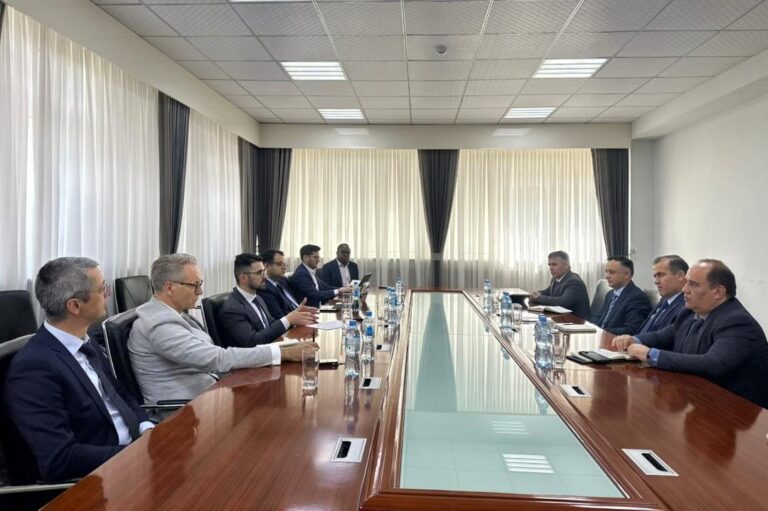
DUSHANBE, April 23, Asia-Plus — The second meeting of a Task Force on regional Electricity Cooperation in Central and South Asia opened in Dushanbe today.
A source at the Ministry of Energy and Industries (MoEI) said that the meeting had brought together representatives of Afghanistan, Kazakhstan, Kyrgyzstan, Pakistan, Tajikistan and Uzbekistan to consider issues related to international practice of creation of cross-border electricity markets. They are also discussing their interests and obligations on developing model agreements for cross-border electricity projects. They are also considering issues related to regulation of hydropower regimes in order to use experience of other regions.
In the meantime, special workshop on hydropower management in Central Asia was held in the Tajik capital yesterday. The workshop assessed the present state of cooperation in Central Asia and discussed efficient methods of management of hydropower in the region. The seminar participants also exchanged views on ways to strengthen regional cooperation.
The Task Force’s meeting and the workshop are organized by a MoEI and the Energy Charter Secretariat.
We will recall that six countries from Central and South Asia held the first meeting of a Task Force on Regional Electricity Cooperation at the Ministry of Foreign Affairs of the Islamic Republic of Afghanistan in Kabul on 18 November. The meeting was organized by the Energy Charter Secretariat and the Government of Afghanistan, with financial assistance from the Government of Norway. The meeting underlined the importance of establishing links in the power sector between economies with high energy demand in South Asia and the energy-rich countries of Central Asia, based on the shared interest in bringing prosperity to the people of the region.
Delegations from Afghanistan, Kazakhstan, Kyrgyzstan, Pakistan, Tajikistan and Uzbekistan agreed a declaration (the ‘
Kabul Declaration on Promoting Regional Electricity Cooperation between Central and South Asia
’) in which they resolved to work towards a joint understanding of the legal and technical framework for regional power trade, based on the principles of the Energy Charter and the provisions of the Energy Charter Treaty.
They also proposed that the
Energy Charter’s Model Agreements
, currently developed for cross-border oil and gas pipelines, should be adapted to provide a basis for cross-border electricity projects.