KHOROG, February 13, 2011, Asia-Plus — One hundred years have passed since Lake Sarez formed in Gorno Badakhshan.
“A strong tremor was felt in Khorog on February 12, 1911, about midnight. In the village of Sarez, people rushed out of their houses, screaming with horror. Two houses collapsed, four gave cracks. A wild ramble was heard from the west. It merged with the howl of falling avalanches. In the morning, every thing was covered with dust hanging in the air, and the land continued to shake. When the boys reached Usoy, they did not see the village. A huge mountain of rock was in its place.” That was the beginning of the Lake Sarez story.
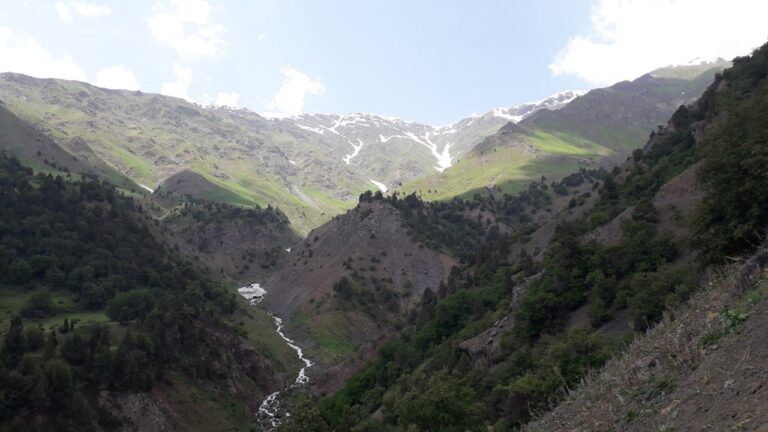
The earthquake was reportedly estimated at 6.5-7.0 on Richter scale. Deaths were estimated at 302. The landslide was 2.2 million cubic meters and formed the Usoy Dam, which is 3km long and 550m high, the tallest natural dam in the world. The village of Usoy was buried under the landslide. It was not until April 1914 that the lake rose high enough to begin flowing over the dam. The lake reached its current level in 1920. The area was so isolated and the destruction of mountain tracks so complete that it took six weeks before word reached the Russian posts at Murgab and Khorog.
According to the book “Tajikistan and the High Pamirs” by Robert Middleton and Huw Thomas, a landslide caused two meter high waves in the lake in 1968. A 1997 conference in Dushanbe concluded that the dam was unstable and might collapse if there were another powerful earthquake.
In 2000, the Lake Sarez Risk Mitigation Project (LSRMP) was launched. The project aiming at reducing the risk related to the natural structure by implementing a monitoring and an early warning system, by training the population leaving downstream and developing long term solutions, is a partnership between the Government and the people of Tajikistan, the World Bank and the donor community represented by the Swiss State Secretariat for Economic Affairs (SECO), the Aga Khan Foundation (AKF), and the United States Agency for International Development (USAID). The main Tajik counterpart for the project is the Committee for emergency Situations (CES).
A 2004 study by the World Bank held that the dam was stable. The principal danger seems to be a partially detached mass of rock of about 3 cubic kilometers that could break loose and fall into the lake. Since the valley below the dam is so narrow, any flood would be very destructive.
The GBAO emergencies official Sadonsho Navruzshoyev says an early warning system installed with support from the Government of Switzerland automatically inform the administrative center of Rushan district, Khorog and Dushanbe of any natural changes taking place in the Lake Sarez area. A special directorate on use of the Usoy system and Lake Sarez problems has been established in Dushanbe.
“More than 80 Codan radio transmitters have been installed,” said Navruzshoyev, “Part of them have been installed along Lake Sarez as well as the Bartang and Panj rivers.”
The GBAO emergency management agency jointly with international humanitarian organization, FOCUS, conducts special training for the population leaving downstream, the GBAO emergencies official added.