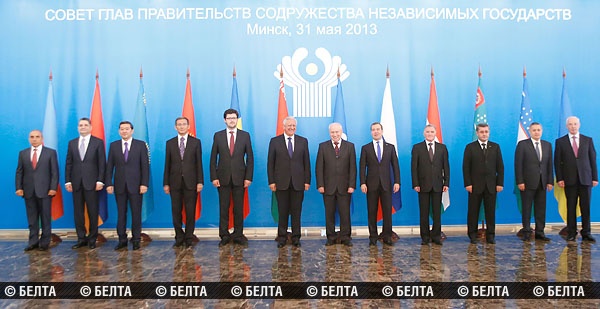
DUSHANBE, June 1, 2013, Asia-Plus — A session of the CIS Council of Heads of Government that took place in Minsk, Belarus on May 31 reportedly considered a broad range of issues related to the state and further expansion of economic, security and humanitarian cooperation between the CIS member nations.
The results of the implementation of CIS interstate innovation cooperation program in 2012 were also among major topics of the meeting.
The meeting participants considered issues related to creation of the CIS innovation patent database that will facilitate the accelerated commercialization of the results of the scientific and technical activity and development of entrepreneurship in the innovation sphere within the CIS area.
According to the CIS Executive Committee, the Protocol on Application of the Treaty on the CIS Free Trade Zone of October 18, 2011 between its Signatory Parties and Uzbekistan was signed during the session. This document reportedly determines legal mechanisms of relations between Uzbekistan and the Signatory Parties to the Treaty.
To-date, the Treaty has come into force for Armenia, Belarus, Kazakhstan, Moldova, Russia, and Ukraine. Tajikistan and Kyrgyzstan have not ratified this document yet.
The next session of the CIS Council of Heads of Government will take place in Moscow on November 20, 2013.
The CIS Council of Heads of Government was established on December 21, 1991. The council is the second major body in the CIS after the CIS Council of Heads of State, and consists of the prime ministers of all member states. The council coordinates the CIS member states” cooperation in economic, social and other areas of their common interests, and adopts corresponding decisions through consensus. The CIS Council of Heads of Government convenes twice a year, normally in winter and autumn. Extraordinary meetings are summoned on the initiative of the government of a member state.
Established on December 1991 after the dissolution of the Soviet Union, the Commonwealth of Independent States (CIS) is a regional organization. It now consists of Azerbaijan, Armenia, Belarus, Kazakhstan, Kyrgyzstan, Moldova, Russia, Tajikistan, Turkmenistan, Uzbekistan and Ukraine. Georgia pulled out of the organization in 2009.