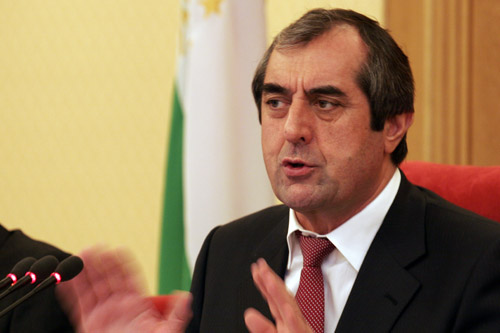
DUSHANBE, June 6, 2013, Asia-Plus – On the occasion of the National Unity Day, which is celebrated on June 27, the website of the Dushanbe mayor’s office has posted an article by Mayor Mahmadsaid Ubaidulloyev about factors that could threaten integrity and unity of Tajikistan.
According to the mayor, integrity of society and the state today depends on not only internal factors but also on the external ones, including international relations, the threat of globalization and so forth.
“Today some external forces use their opportunities, including the military ones, to further their goals. But both eastern and western researchers note that civil society could be created through knowledge and respect for rights of others but not through pressure and violence,” the mayor says.
According to him, there are still factors in Tajikistan that threaten the national unity. Among them are environmental threats, international terrorism, transnational crime groups, drug trafficking and growing number of religious extremists.
Ubaidulloyev notes that that there were forces that were not interested in the unity and stability in Tajikistan and it was necessary to use the whole potential of the government, civil society and political parties to oppose those forces.
This year is the 16th anniversary of the National Unity Day of Tajikistan. Sixteen years ago, on June 27, 1997, the confronting sides signed in Moscow the General Agreement on the Establishment of Peace and National Accord in Tajikistan. For the purposes of achieving peace and national accord in Tajikistan and overcoming the consequences of the civil war, inter-Tajik talks on national reconciliation were conducted from April 1994 to 1997 under the auspices of the United Nations.
Protocols that were agreed and signed in the course of eight rounds of talks between delegations of the Government of Tajikistan and the United Tajik Opposition (UTO), six meetings between the President of Tajikistan and the UTO leader, and also three rounds of consultations between the delegations of the sides in Almaty, Ashgabat, Bishkek, Islamabad, Kabul, Mashhad (Iran), Moscow, Tehran and Khusdeh (Afghanistan) constituted the General Agreement on the Establishment of Peace and National Accord in Tajikistan.