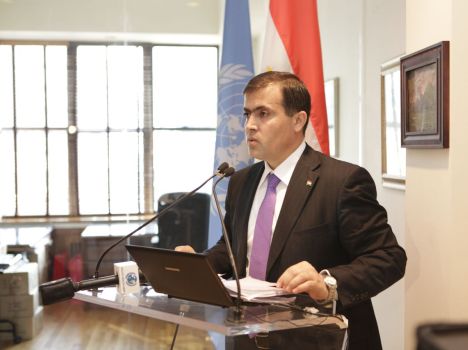
DUSHANBE, February 14, 2014, Asia-Plus – An article “Tajikistan: Turn Water into Cooperation” by Tajik First Deputy Minister of Energy and Water Resources Sulton Rahimov that was published in EP Today, a monthly newspaper for European Parliament, on February 9 notes that lack of fuel and energy resources and reduction of river flow in winter in Tajikistan create a serious shortage of electricity in the autumn-winter period.
Obstacles in the import and transit of electricity from other countries make this problem even more acute. This has been going on for about 15 years and strongly affects the socio-economic situation in the country.
The article notes that in Tajikistan as well as throughout the world climate change is clearly observed. Over the past 65 years in broad valleys the average annual temperature has increased by 0,7-1,200C in mountain areas by 0.1-0.70C and in cities by 1.2-1,900C. Due to the impact of the climate change, the glaciers of the country have changed and according to some estimates have lost 20% of the volume and 30% of the area over the past 50-60 years.
Lack of fuel and energy resources and the use of water as a main source for power generation along with the strategic importance of water for drinking and agriculture reportedly make Tajikistan highly vulnerable to water and therefore Government of the country gives the highest priority to solving water issues at all levels.
Rahimov also notes that Tajikistan’s hydropower potential is estimated at 527 billion kWh per year which three times exceeds the existing electricity consumption of the countries of Central Asia. In terms of potential hydropower resources Tajikistan is ranked the eighth in the world, after China, Russia, USA, Brazil, Zaire, India and Canada. On specific indicators of hydropower potential per square kilometer (3696.9 thousand kWh per year/km2) and per capita (65.9 thousand kWh per year/person) the country occupies the first and second place in the world accordingly.
According to him, the current use of hydropower resources in Tajikistan allows producing about 17 billion kWh of electricity per year which is about 3 % of the existing capacity. The share of hydropower in the general scheme of fuel and energy balance of the country is more than 98 %. The main consumers of electricity in the country are industry, agriculture, transport and communications, household sector. In principle these sectors are the key in economic development as it is evidenced by the structure of the country’s GDP.
Tajik official notes that with huge reserves of water resources and hydropower potential, Tajikistan has repeatedly stated its willingness to cooperate for mutual benefit with all stakeholders and especially with the neighboring countries for their effective and efficient use for the benefit of all countries in the region. Joint development of this huge potential could contribute to an integrated solution to many current and future issues in Central Asia.
Rahimov stressed that the water-power resources of Tajikistan might be the main catalyst for sustainable development and integration processes in the Central Asian region. On this approach the main slogan of Tajikistan’s water policy is: “Turn water into cooperation.”