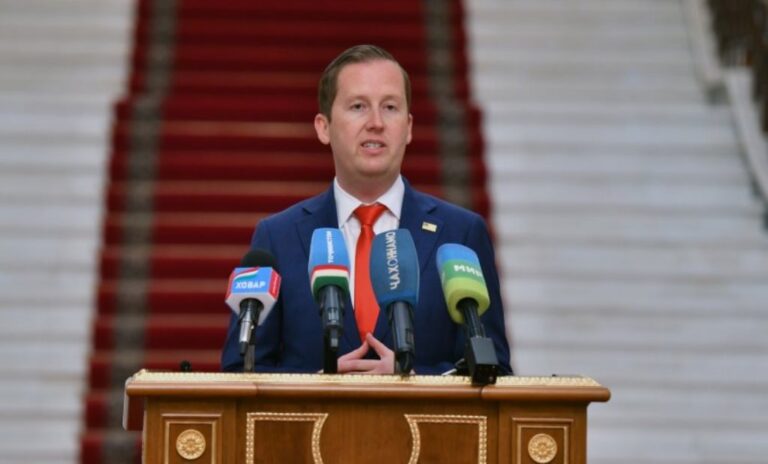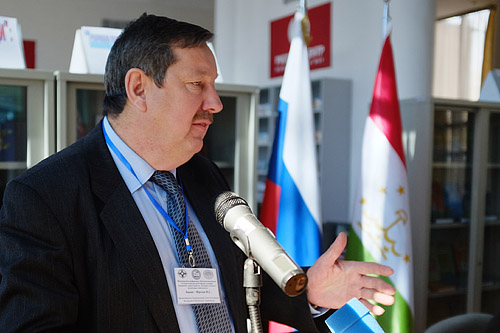
DUSHANBE, March 27, 2014, Asia-Plus — To achieve its political goals the United States does not hesitate to work to the detriment of great international tasks such as the fight against drug trafficking, Russian Ambassador to Tajikistan Igor Lyakin-Frolov stated at an international conference entitled “Problems of Security of Central Eurasia’s Nations under Conditions of Modern World Order: Trends and Approaches to Providing Stability” that took place in Dushanbe on March 27.
“The United States has decided to suspend cooperation with Russia in combating drug trafficking that is evidence of the fact that great international tasks such as the fight against drug trafficking are sacrificed for the sake of political interests,” Ambassador Lyakin-Frolov noted.
Russian diplomat drew attention of the conference participants to the fact that this decision also indirectly applies to the nations that jointly with Russia are taking measures against drug trafficking.
According to him, factors reducing global sustainability, provoking conflicts and lowering ability of international community to reach an agreement on acute issue s and matters of principle have become stronger in recent years.
“Events in former Yugoslavia, Iraq, northern Africa, Afghanistan and in Ukraine corroborate that the world is faced with a serious system of crises; a tectonic process of global transformation is under way,” Russian diplomat noted.
“We are becoming witnesses of degradation of key international institutions, substitution of principles of international law, unwillingness of taking into consideration interests of others that leads to weakening of international and regional security,” Ambassador Lyakin-Frolov stressed.
Organized by the Center for Geopolitical Studies at Russian-Tajik Slavic University (RTSU) under support of the Russian Embassy in Dushanbe and the Collective Security Treaty Organization (CSTO) Secretariat, the conference has brought together 80 researchers and experts to discuss a role of external factors in subsystem of international relations in Central Eurasia.
The following themes were discussed at the conference: network wars and information aspects of providing stability in Central Asia; post-Soviet Asia and Afghanistan; realities, main internal political risks, geopolitical perspectives, and humanitarian aspects of cooperation between Central Eurasia’s nations: priorities and perspectives; and CSTO as factor o security and stability in Central Eurasia.