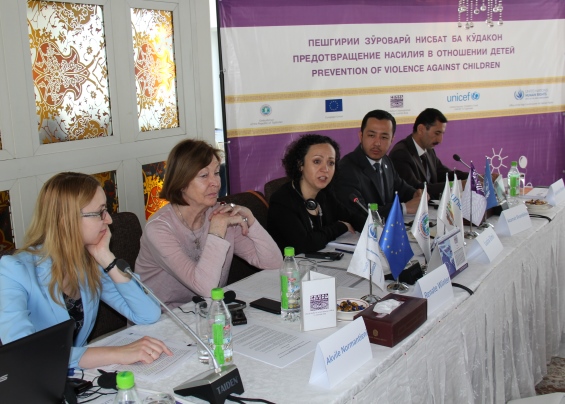
DUSHANBE, May 26, 2015, Asia-Plus – Launched on May 25, a three-day training for the staff of the penal system, law enforcement agencies, closed institutions and human rights organizations in Tajikistan is going on in Dushanbe.
The training is organized by Penal Reform International office in Central Asia within the framework of the project, Progressive Abolition of Violence against Children in Detention in Central Asia, and its main objective is to enhance the capacity of employees of the closed institutions on children”s rights and prevention of violence against children, the use of international standards on treatment of children in the closed institutions.
According to the European Union Delegation to Tajikistan, the training is being delivered by the Vice-President of the UN Committee on the Rights of the Child, international experts from Serbia and Kyrgyzstan, and national experts from Tajikistan.
The training is coorganized by the United Nations Children”s Fund (UNICEF) in Tajikistan and the Office of High Commissioner for Human Rights for Central Asia.
Protection of children from torture and ill-treatment takes an important place. Impunity for torture against children leads to the fact that children who are not granted protection, find violence, and not the legal mechanisms, as the only reliable way to solve problems and get results in life. Violence against children is often the unnoticed and unregistered fact. Research on violence, conducted in 2006 by the UN Committee on the Rights of the Child proved that children in guardianship institutions and in detention are at greater risk than practically all the other children. Despite the efforts of the State, the joint monitoring of children’s rights by the National Institute on Human Rights and the civil society organizations indicate, that the prevalence of violence against children in closed institutions in Tajikistan is high.
The project, Progressive Abolition of Violence against Children in Detention in Central Asia, is funded by the European Union and aimed to reduce the number of cases of violence against children in closed institutions, to eliminate the use of solitary confinement, and to separate children from adults and girls from boys at all times and in all places of detention. The project is implemented jointly with the national Human Rights institutions (Ombudsman of Kazakhstan, Kyrgyzstan and Tajikistan).
The given project envisages implementation of the international standards for the protection of child’s rights in the framework of national legislation, legal support for children in difficult circumstances, educational programs for employees of the closed institutions, the development of psychological rehabilitation programs for children affected by violence and a number of other activities.
In Tajikistan, the project is being implemented by Penal Reform International Office in Central Asia (PRI) in cooperation with Ombudsman Office in Tajikistan.