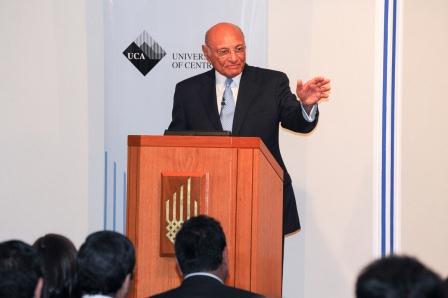
DUSHANBE, May 30, 2016, Asia-Plus — The University of Central Asia (UCA) Board Executive Committee Executive Chairman and Aga Khan Development Network (AKDN) Diplomatic Representative to Kyrgyzstan Shamsh Kassim-Lakha delivered a talk Creating Opportunity on the Roof of the World, according to press released issued by UCA. He reportedly spoke in London on May 20, 2016 as part of the Aga Khan Foundation United Kingdom’s (AKF UK) Breaking the Cycle of Poverty lecture series.
UCA is building three campuses of equal facility and standards in Naryn, Kyrgyzstan (2016), Khorog, Tajikistan (2017), and Tekeli, Kazakhstan (anticipated 2019).
Kassim-Lakha addressed the diverse audience, which included representatives from government, the diplomatic corps, media, the donor community, and the wider public, emphasizing the strategic importance of the Central Asian region in a globalized world.
“There is an inverse ratio between the height of the mountain and the economic status of those who inhabit it; the higher the mountain, the lower the economic status. There is resilience and initiative within mountain communities,” said Kassim-Lakha. “Education bridges the divide. We want to give communities the opportunity to reverse this risk of marginalization through higher education.”
The University is pursuing applied research through its Mountain Societies Research Institute (MSRI), IPPA and the Cultural Heritage and Humanities Unit (CHHU). UCA’s Aga Khan Humanities Project (AKHP) partners with state universities in the region, providing an innovative humanities curriculum that promotes civic awareness, liberal arts and analytical writing.
“Research is very important. We need to create knowledge in order to develop job creators. We need to find opportunities, and that comes out of the intellectual application of minds, creating research and fostering socio-economic development of Central Asia’s mountain based societies, and helping societies preserve and draw upon their rich cultural heritage,” said Kassim-Lakha.
Kassim-Lakha also related the School of Professional and Continuing Education’s (SPCE) long-standing contribution to the region by providing training to more than 85,000 learners at 12 locations in Central Asia and Afghanistan. More than half of the learners are under 25 and nearly 70 percent have been women.
Responding to a question from a member of the audience from Naryn on the decision to also offer undergraduate specializations in Computer Science, Kassim-Lakha explained the need to expand opportunities in the industries of the future.
“We have to bring opportunities to the mountains. We have to ensure modern technologies, modern means of communications in the best form are brought to mountain communities,” explained Kassim-Lakha, noting that the Nielsen company conducted an in-depth market survey to determine where future jobs lie and what the future of Central Asian economic development entails. He noted that UCA’s Computer Science program received the largest number of applicants during its recently completed admissions campaign.
UCA will offer integrative undergraduate degree programs in Computer Science, Communications and Media in Naryn and Economics and Earth and Environmental Science at the Khorog campus. The Tekeli, Kazakhstan campus will offer Engineering Sciences and Business and Management.
The University is estimated to generate more than $750 million in projected economic impact of the region, including more than 1,000 construction jobs and 300 new faculty and staff positions.
UCA undergraduate education is delivered in English and rooted in a liberal arts approach to encourage graduates to be globally competitive. Admission to UCA is merit-based and the University offers generous financial aid; no student will be denied admission based on need.
The University of Central Asia (UCA) was founded in 2000 to offer an internationally recognized standard of higher education and prepare graduates to contribute leadership, ideas and innovation to the economies and communities of the region. The International Treaty and Charter establishing this private, secular University was signed by the Presidents of Tajikistan, Kyrgyzstan and Kazakhstan and His Highness the Aga Khan, ratified by the parliaments of the founding states and registered with the United Nations. UCA is the first internationally chartered university in the world. UCA’s mission is to foster the socio-economic development of Central Asia, particularly its mountain societies, while helping the peoples of the region preserve and draw upon their rich cultural heritages as assets for the future. UCA brings with it the commitment and partnership of the Aga Khan Development Network (AKDN).