Japan’s government supports enhancement of education sector in Khatlon province

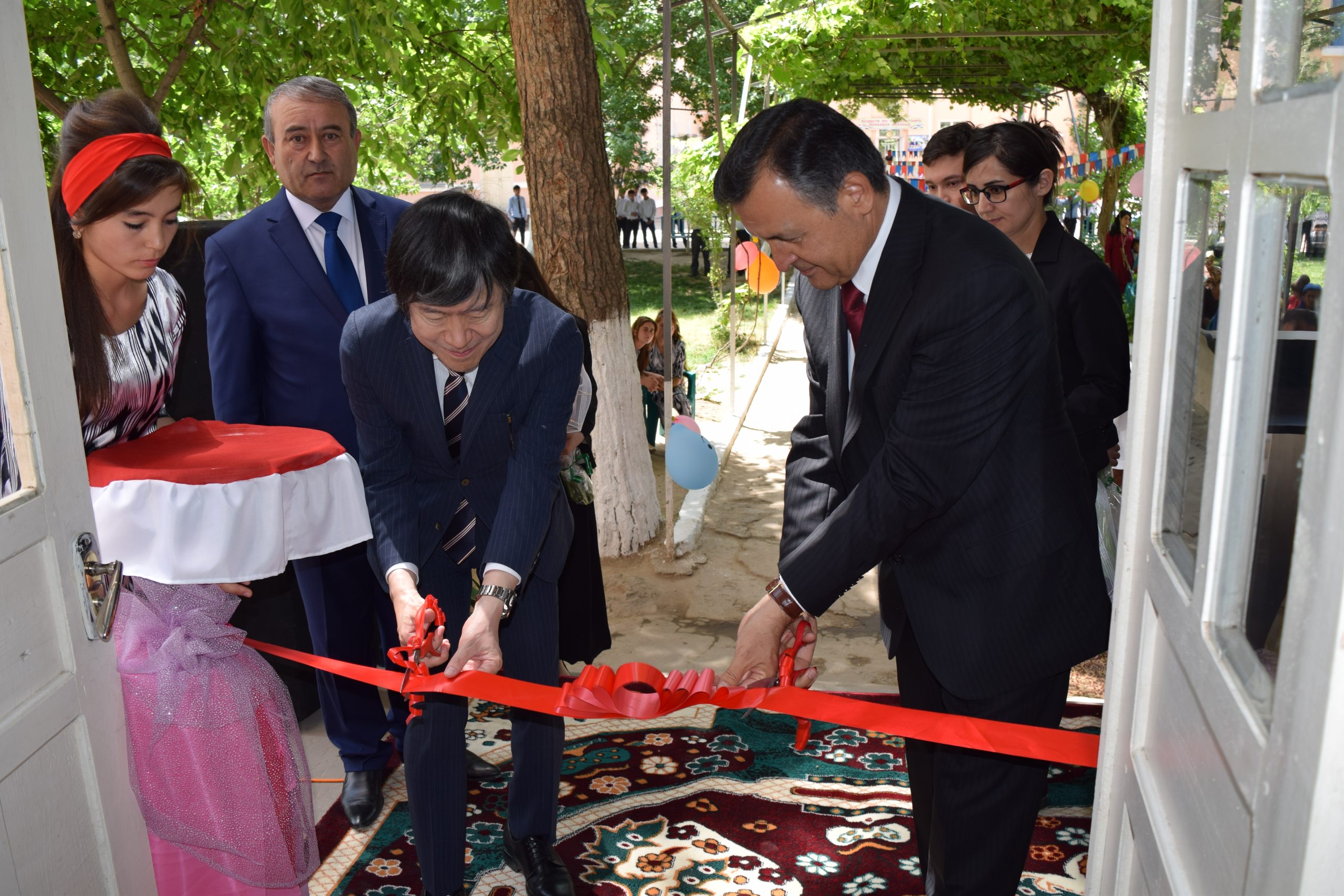
On May 19, Mr. Hajime Kitaoka, Japan’s Ambassador to Tajikistan, attended the handover ceremony for the GGP project: “The Project for the Rehabilitation of Child Welfare Institution-Cum-Boarding School in Vakhsh District” of Khatlon province. According to the Japanese Embassy in Dushanbe, the ceremony was held to commemorate successful completion of the project that was funded […]

Asia-Plus

On May 19, Mr. Hajime Kitaoka, Japan’s Ambassador to Tajikistan, attended the handover ceremony for the GGP project: “The Project for the Rehabilitation of Child Welfare Institution-Cum-Boarding School in Vakhsh District” of Khatlon province.

According to the Japanese Embassy in Dushanbe, the ceremony was held to commemorate successful completion of the project that was funded by the Government of Japan through its scheme of “Grant Assistance for Grassroots Human Security Projects (GGP)”.  The ceremony was attended by the Khatlon governor Davlatsho Gulmahmadzoda, head of Vakhsh district Sharbatullo Azizullo as well as representatives of education sector, parents, students, and community members.

For implementation of the project, total grant amount of USD 83,812 was allocated for installation of heating system of the Boarding school building.  With a new heating system, educational environment of the school was significantly improved.  Through the project, the school was also equipped with 172 beds and cabinets.

During his speech at the handover ceremony, Mr. Hajime Kitaoka stated that GGP projects play a considerable role in making positive impacts for the people of Tajikistan at grassroots level. In addition, he expressed that these projects contribute to the friendship and further expansion of bilateral relationship between the Republic of Tajikistan and Japan.

The governor of the province and head of the district expressed their gratitude for continuous support and contribution of people of Japan for development of the Republic of Tajikistan.

“Grant Assistance for Grassroots Human Security Project” (GGP) is a scheme within Japan’s Official Development Assistance. GGP in particular implements grassroots-level projects in various sectors throughout the Republic of Tajikistan.  Recipients of GGP grants include local governments, educational and medical institutions, and NGOs.  As of today, GGP has supported 376 projects in the Republic of Tajikistan, for which US$ $33.3 million has been allocated since 1996.

Article translations:

Related Article

Оби зулол

Most Read

Join us on social media!

Aura

Recent Articles

Sanctions lifted: Dushanbe City Bank resumes international operations

The bank is returning to full-scale international operations.

Gasoline and diesel fuel in Dushanbe rose in price by 8.9% due to the war in the Middle East

The rise in global oil prices and, consequently, the cost of petroleum products has triggered the closure of the Strait of Hormuz.

The Ministry of Labor organizes consultations for migrants returning from Russia at Dushanbe airport

Employees of the Migration Service explain the requirements of Russian legislation and offer job vacancies in their homeland.

Tajikistan and Uzbekistan discuss simplification of customs procedures and implementation of VIN.TJ system

The VIN.TJ system is designed to simplify the process of vehicle registration and control.

Tajikistan climbs four places in the global fixed internet speed ranking

This is the country's best performance in the past five years.

President of Tajikistan launches hydro unit No. 7 at Nurek HPP

As of today, three units have been completely replaced at the country's largest hydroelectric power station.

Italian Opera in Dushanbe: Shohrukh Yunusov invites to an evening of musical revelations

The evening will feature the most recognizable Italian works alongside world and Tajik classics.

The European Union lifts sanctions on Tajik banks

This is attributed to successful reforms and improved financial transparency in the country.

Meta announced plans to lay off about 10% of its staff

The reason cited is the high costs of artificial intelligence development.