Economist of the International Monetary Fund Edward Nolan will work in the National Bank of Tajikistan as a long-term adviser. The Fund specialist will improve banking supervision and regulation.
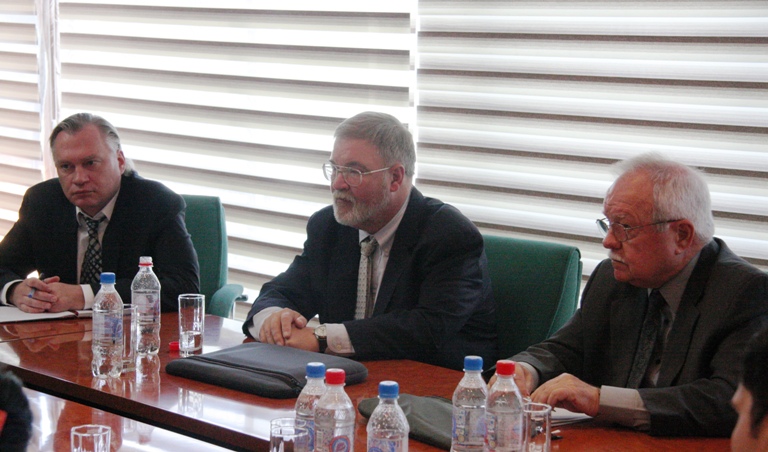
The IMF economist's presentation was held recently during the meeting of the first deputy head of the NBT, Jamoliddin Nuraliev and the senior economist of the Phillip Bartholomew Foundation in Dushanbe.
The parties discussed the prospects for financial cooperation, as well as the provision of technical assistance IMF to strengthen banking supervision.
Nuraliyev noted that the main problem of the Tajik banking system is a large number of inactive loans, difficulties related to liquidity and inefficient corporate governance in financial institutions. He stressed that in this regard, the NBT, in the framework of technical assistance, needs to attract advisers.
Phillip Bartholomew said that he is following closely the current state of the Tajik banking system, analyzing the situation.
He stressed that one of the main goals of this IMF delegation's visit to Tajikistan is the presentation of long-term adviser in the field of banking supervision of Edward Nolan. Edward Nolan, as a specialist in banking supervision, corporate governance and credit risk management, has extensive experience in working with central banks in a number of countries, such as Hungary, Slovakia and Kosovo.
Within a year he will work in the NBT in order to improve banking supervision and regulation. The IMF economist plans to operate in three areas: analysis of banking and reporting, verification of the activities of credit institutions and consolidated supervision of credit institutions.
The banking sector of Tajikistan is very badly frightened from the beginning of last year. During this period, licenses were obtained from two banks (Tajprombank and Fononbank), the liquidation process of which is currently ongoing. Two more system-forming banks of the country (Agroinvestbank and Tojiksodirotbank) were saved by the government's financial support, which together amounted to almost $ 500 million.
Meanwhile, the World Bank's report on Tajikistan's economy states that the first signs of a crisis in Tajikistan's financial sector were evident in early 2013, when the ratio of non-performing loans unexpectedly doubled to 15.9% from 8% in 2010-2011.
Analysts of the bank warn that the ongoing analysis of the quality of assets of Tajik banks can reveal new requirements for their capitalization, which will cost the republic's budget additional costs.