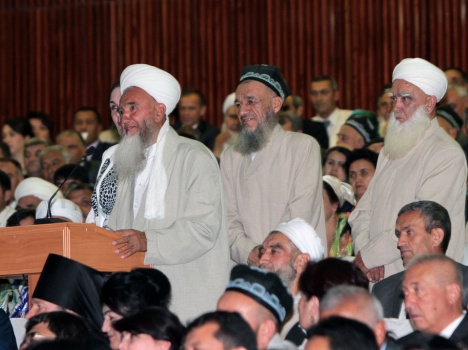
A group of imam-khatibs from Tajikistan will visit Moscow soon to carry out explanatory work among Tajik migrants over the problems of radicalization among Tajik migrant workers in Russia, according to the Committee on Religious Affairs (CRA) under the Government of Tajikistan.
“A group of imam-khatibs will visit Russia to carry out education and awareness-raising work among our migrants living in the Russian Federation.” CRA head Husein Shokirzoda told Asia-Plus in an interview.
Earlier, youth organizations and parliamentarians had also been engaged in carrying out explanatory work on prevention of radicalization of Tajik labor migrants living in the Russian Federation, Shokirzoda noted.
Meanwhile, Tajik power-wielding structures consider that Moscow grand mufti’s concerns over the danger of radicalization of Tajik migrants are reasonable.
The problem of the radicalization of Tajik migrants working Russia is under the constant control of the special services of Tajikistan and Russia,” a source at the Tajik law enforcement authorities told Asia-Plus in an interview.
According to him, dozens of Tajiks fighting alongside the Islamic State (IS) terror organization militants in Syria and Iraq were recruited while working as labor migrants in Russia.
Tajik expert Qosim Bekmuhammad notes that Tajik labor migrants working in the Russian Federation are potential targets for recruitment by terrorist and extremist organizations.
“Our labor migrants working in Russia are very vulnerable because the majority of them are constantly under the pressure of Russian power-wielding structures, and therefore, they show interest in joining extremist groups,” said the expert said. “Very few Tajik migrants have managed to integrate in Russian society, while the others are being recruited by terrorists through social networks.”
He further noted that the “Khorasan” group cannot replace the IS terror group because it is the IS wing in Afghanistan.
It is to be noted that Tajikistan and Kyrgyzstan are the most migration-dependent economies in the world. Islamist recruiters have targeted those working abroad. According to some sources, between five and seven million citizens of Kyrgyzstan, Tajikistan and Uzbekistan — mainly young men — live and work in Russia. Often spending their late-adolescence away from their family home, they are subject to daily economic hardship, racial abuse and state harassment.