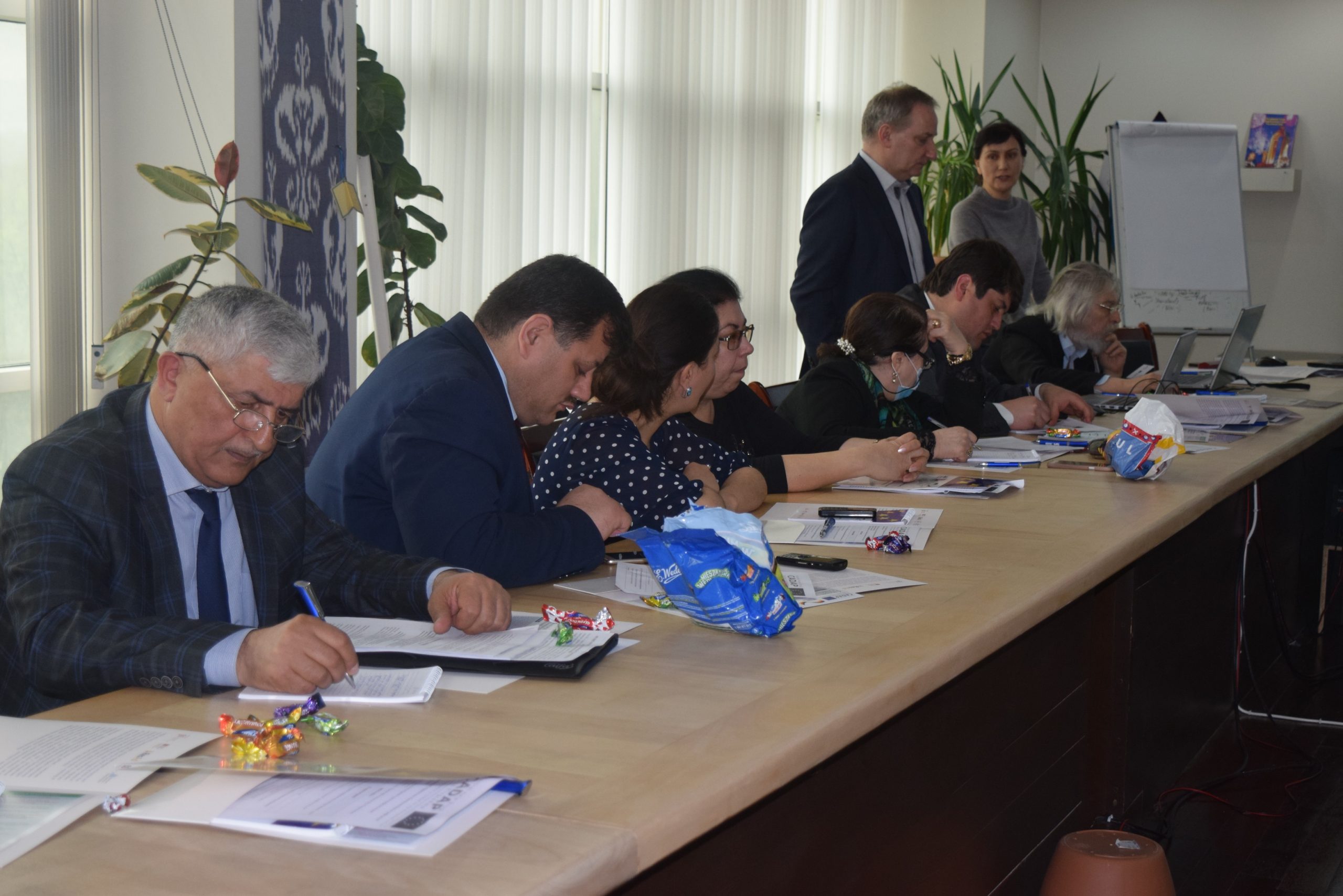
Tajik and EU experts discuss the first results of the prevention program for adolescents

Twenty-five national partners from Ministry of Education and Sciences, National Center for Monitoring and Prevention of Drug Use, Narcology Service, Healthy Life Style Center, Youth Friendly Service, Drug Control Agency, Ministry of Internal Affairs, Tajik National University, Tajik State Medical University, secondary schools in Dushanbe and NGOs yesterday discussed the results of the pilot drug […]

Twenty-five national partners from Ministry of Education and Sciences, National Center for Monitoring and Prevention of Drug Use, Narcology Service, Healthy Life Style Center, Youth Friendly Service, Drug Control Agency, Ministry of Internal Affairs, Tajik National University, Tajik State Medical University, secondary schools in Dushanbe and NGOs yesterday discussed the results of the pilot drug prevention program, which was completed in 5 secondary schools in Dushanbe in September – December 2017.

According to the European Union (EU) Delegation to Tajikistan, the participants of the seminar made both qualitative and quantitative evaluation of the program and in small groups reviewed and modified scenarios of the possible program for the youth at risk.  

They reportedly discussed the possible modifications and improvements if the program or other preventive work with youth at risk continues in the future.

In Tajikistan, 5 schools in Dushanbe were involved and 43 adolescents were covered by the Indicative Prevention Program based on the motivational interviewing.

This program relates to the indicative drug prevention.  Earlier, in 2016 the universal drug prevention program was successfully tested in Tajikistan with participation of about 13000 parents, 513 teachers, 36 instructors and 2 national trainers who were trained in school-based drug prevention program.  36 schools participated in pilot prevention campaigns in 6 localities.

CADAP 6 represents continuity of the EU policy and long-term engagement with Central Asian partners to help further strengthen their national strategies in drug and drug demand reduction policies.  The program is funded by the European Union and implemented by the Consortium from the Netherlands, Czech Republic, Poland and Germany, led by the Deutsche Gesellschaft für Internationale Zusammenarbeit (GIZ) GmbH.

Join us on social media!

Article translations:

Related Article

Tenisi
Оби зулол
Оби зулол

Most Read

Коммерсбонк Точикистон

Recent Articles

RZD announces the restoration of passenger services between Moscow and Dushanbe

Direct rail services between the capitals of Russia and Tajikistan were suspended in March 2020 due to the COVID-19 pandemic.

#AP30/Stories. “Selam! Heller nichek?” How Tatars live today in Sughd province

On the 30th anniversary of "Asia-Plus," we continue to publish reports that remain relevant even after years. This story was told in 2021, and since then, little has changed in the life of the Tatar community in Tajikistan.

15,000 cameras, drones, and robots: how technology monitors pilgrims in Mecca and Medina

During Hajj 2026, Mecca and Medina were under unprecedented digital control.

Another child in Dushanbe removed from family and sent to boarding school

The Ministry of Internal Affairs reports that the parents did not pay adequate attention to the child.

Emomali Rahmon instructs to address issues in seed production following criticism of the industry

Issues have been noted with certification, seed quality, and the material and technical base of the industry.

Water, climate, and a $130 billion deficit: seven key outcomes of the Water Conference in Dushanbe

At the forum, countries and international organizations discussed new mechanisms for cooperation, investments, and technologies that are essential for addressing the global water crisis.

Eskhata Bank introduces a new generation children’s wallet

"Eshkata Bank" has created a full-fledged digital platform that helps children aged 7 to 16 learn how to manage money.