



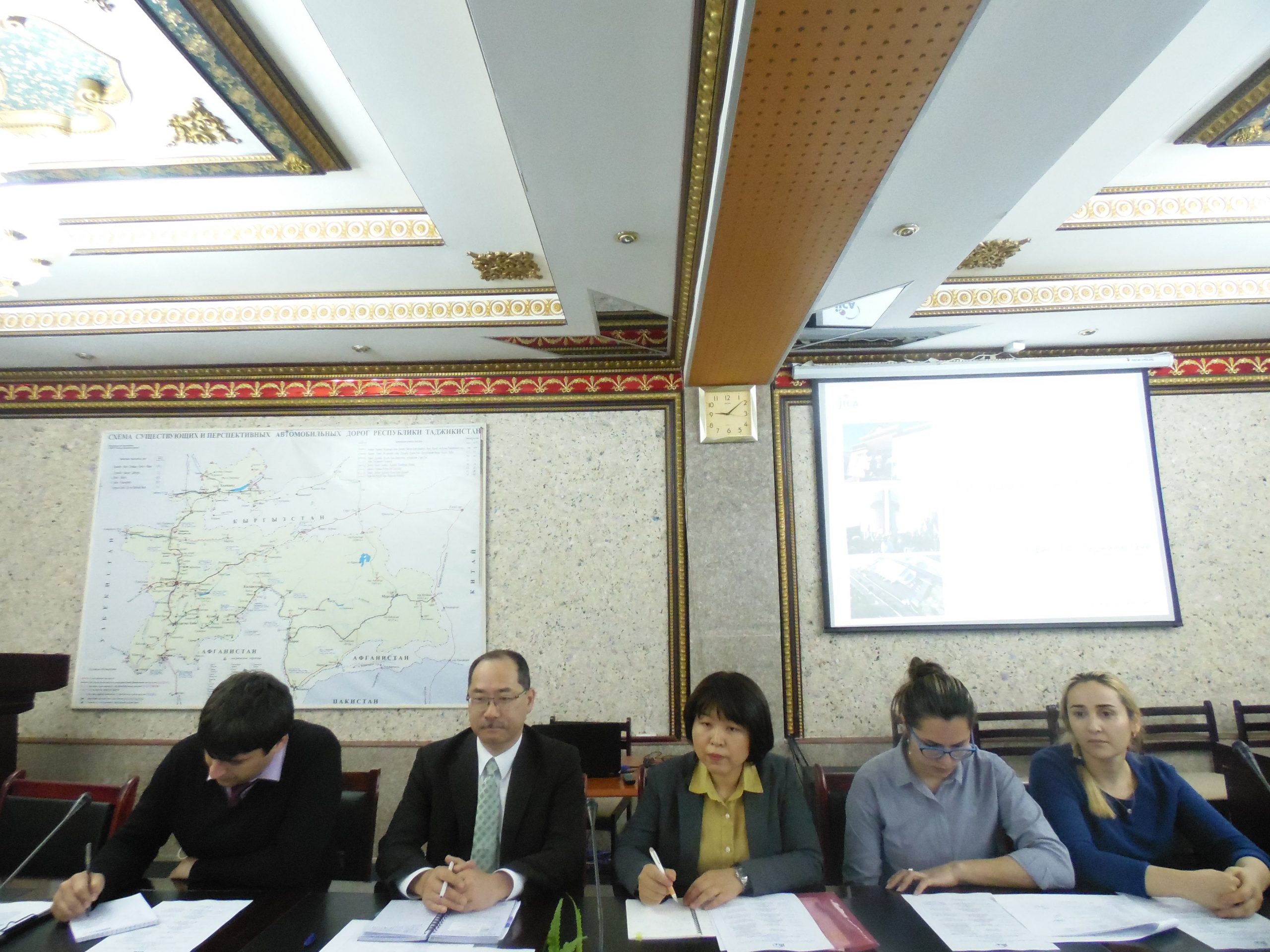
Ex-participants of JICA Training Courses on Transport have conducted a seminar to identify priorities of activities based on Japanese experience at the Ministry of Transport of the Republic of Tajikistan.
JICA Tajikistan Office says the main purpose of the seminar was to discuss ideas and proposals of the ex-participants about the development of transport and logistics in Tajikistan.
The seminar was attended by Mr. Sherali Ganjalzoda, Deputy Minister of Transport, Mr. Hideki Tanabe, Chief Representative of JICA Tajikistan Office, other representatives of the Ministry of Transport and JICA.
During his opening speech, Mr. Sherali Ganjalzoda stated that Tajikistan and Japan had rich experience in improving infrastructure as well as developing human resources, emphasizing the importance of follow-up support of activities implemented by JICA ex-participants.
Mr. Hideki Tanabe expressed a hope that the specialists who attended JICA training courses would apply the knowledge and experience gained in Japan in implementing the strategic goals stated in the National Development Strategy 2030 of Tajikistan.
Specialists of the Ministry of Transport and its regional divisions in Hisor and Rasht made presentations on topical issues such as developing inventory for bridges to improve bridge maintenance, introducing a monitoring system of passenger transport in Dushanbe, rehabilitating and equipping of repair workshops for road maintenance equipment and machineries and planting trees to prevent avalanches.
At the end of the seminar, it was mentioned that JICA and the Ministry of Transport need to continue making efforts to develop transport sector, especially to build capacity of the ministry’s staffs in transport infrastructure development and road asset management. In particular, the importance of organizing training courses in transport policy and administration was highlighted.
JICA began its technical cooperation with Tajikistan in 1993 by inviting Tajik officials to gain knowledge and experience on governance and macroeconomics development. As of January 2018, a total number of participants to JICA’s Knowledge Co-Creation Programs, formerly called the Training Programs, has exceeded 2100 people. JICA Office was established in 2006 in Tajikistan and since then various Grant Financial Assistance and Technical Cooperation projects have been implemented more dynamically, aiming at improving living standard of Tajik people for the sectors such as agriculture and rural development, water supply, health, transport, energy, capacity building as well as SME promotion. JICA’s cumulative investment portfolio in Tajikistan in all sectors comprises 34 projects amounting to more than 345 million USD (82 million. USD for Technical Cooperation and 263 million USD for Grant Assistance), including 12 on-going projects.







