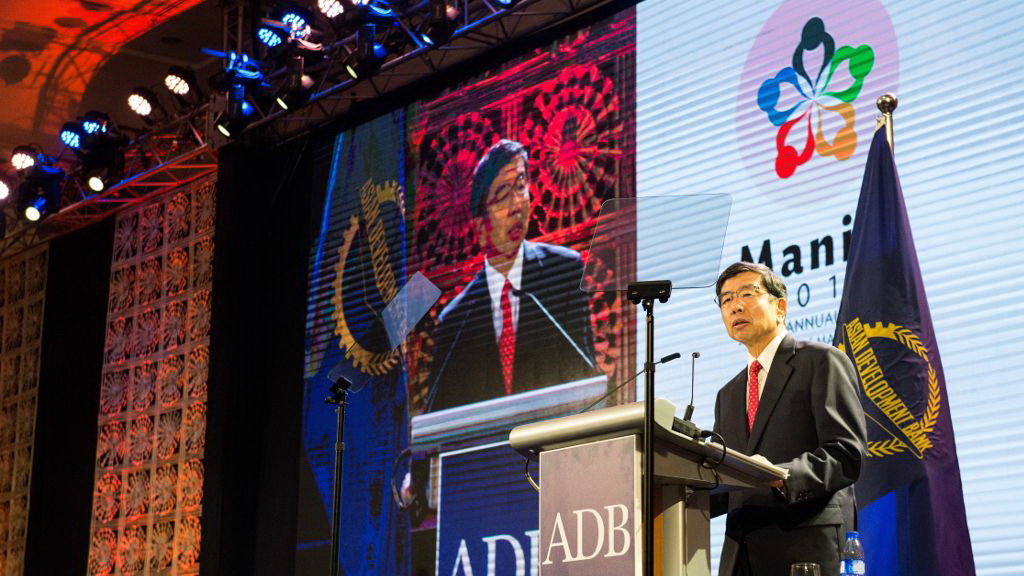
Strategy 2030, the new long-term strategy of the Asian Development Bank (ADB), which will be released this year, will renew ADB’s strong commitment to eradicate extreme poverty in Asia and the Pacific and expand the Bank’s vision to achieve a prosperous, inclusive, resilient, and sustainable region, ADB President Mr. Takehiko Nakao said in his opening address at the 51st Annual Meeting of ADB’s Board of Governors.
Over 4,000 participants including finance ministers, central bank governors, private sector representatives, development partners, academics, members of civil society, and the media gathered at the Asian Development Bank (ADB) headquarters in Manila, Philippines for the event that took place on May 3-6 May.
In the opening address, Mr. Nakao appreciated the strong support of the Philippines as ADB’s host country since 1966 and thanked the government and its people for the excellent arrangements and warm hospitality. He highlighted Strategy 2030 which is in the consultation process, ADB’s achievements in 2017, continued solid growth of Asian economies, and impacts of new technologies on jobs, according to the ADB Tajikistan Resident Mission (TJRM).
In his remarks, Mr. Nakao said Strategy 2030 will address existing and emerging challenges. “There is still persistent poverty,” said Mr. Nakao. “We must address rising inequality, growing environmental pressures, and rapid urbanization.”
“We will continue to use our financial resources efficiently and creatively,” said Mr. Nakao. “We will invest in our workforce, promote diversity including gender balance, and ensure a respectful workplace. We will expand our presence on the ground. We will dramatically modernize business processes to speed up our services to clients.
“A One ADB approach will break down silos and bring together expertise across ADB,” he added.
Recall, the Tajikistan government delegation that participated in the event was headed by Davlatali Said, First Deputy Prime Minister, who is ADB Governor for Tajikistan, and Nematullo Hikmatullozoda, Minister of Economic Development and Trade/ Alternate ADB Governor for Tajikistan.
Strategy 2030 will be aligned with the international agenda, including the Sustainable Development Goals and the Paris Agreement on climate change.
Strategy 2030 will have 10 priorities: (1) tackle remaining poverty and increasing inequalities in Asia and the Pacific; (2) accelerate progress in gender equality; (3) scale up support to combat climate change, build climate and disaster resilience, and enhance environmental sustainability; (4) build livable cities that are competitive, green, resilient, and inclusive; (5) promote rural development and food security; (6) strengthen governance; (7) foster regional cooperation and integration; (8) mobilize private sector resources to meet the region’s huge development financing needs; (9) further strengthen ADB’s role as a provider and facilitator of knowledge; and (10) pursue a stronger, better, and faster ADB.
ADB is celebrating 20 years of development partnership with Tajikistan in 2018. To date, ADB has approved around $1.6 billion in concessional loans, grants, and technical assistance to the country. ADB and Tajikistan’s development partnership, which began in 1998, has restored and built the country’s new transport and energy infrastructure, supported social development, expanded agricultural production, and improved regional cooperation and trade.
ADB, based in Manila, is dedicated to reducing poverty in Asia and the Pacific through inclusive economic growth, environmentally sustainable growth, and regional integration. Established in 1966, it is owned by 67 members—48 from the region. In 2017, ADB operations totaled $32.2 billion, including $11.9 billion in cofinancing.